Showing posts with label Artificial Intelligence. Show all posts

Sunday, August 18, 2019

Review: Autonomous by Annalee Newitz

Autonomous by Annalee Newitz
Published: Tor (2017)
Awards Nominated: Nebula, Campbell Memorial and Locus First Novel Awards

The Book:

“Earth, 2144. Jack is an anti-patent scientist turned drug pirate, traversing the world in a submarine as a pharmaceutical Robin Hood, fabricating cheap scrips for poor people who can't otherwise afford them. But her latest drug hack has left a trail of lethal overdoses as people become addicted to their work, doing repetitive tasks until they become unsafe or insane.

Hot on her trail, an unlikely pair: Eliasz, a brooding military agent, and his robotic partner, Paladin. As they race to stop information about the sinister origins of Jack's drug from getting out, they begin to form an uncommonly close bond that neither of them fully understand. And underlying it all is one fundamental question: Is freedom possible in a culture where everything, even people, can be owned?” ~WWEnd.com

I picked up this book because of all the award attention, and also because the premise sounded like it would make an interesting story.  This is Annalee Newitz’s first novel.

My Thoughts:

The world of Autonomous is a future capitalist nightmare, extrapolated from current trends.  Corporations have far more power than they do now, so laws have shifted to accommodate what is best for them. For instance, patents are permanent and secret, so that pharmaceutical companies can continue to profit on drugs indefinitely.  The question of robotic AI rights vs. human rights is also settled in a way that prioritizes profits -- if robots can be considered human, then humans can also be considered commodities. It’s a pretty dark future, but not a fully unrecognizable one.  It also doesn’t seem completely hopeless, since we see people like Jack fighting against the status quo, even if she isn’t altogether noble.

I enjoyed what I saw of the world-building, but I had a hard time sympathizing with the characters, even though I often like reading about people with major flaws. Eliasz is a murderous homophobe, and, for all their initial naivete, Paladin seems to become similar.  Jack is the most objectively decent main character, but her black market drugs make her responsible for a lot of suffering. In addition, both Jack and Eliasz separately engage in sexual relationships that seem very exploitative, due to uncomfortable power dynamics. I think that part of my issue might have been that I did not feel like their character flaws were sufficiently acknowledged or addressed within the story. 

Even if they didn’t engage me emotionally, some of the characters were pretty fun to read about.  I enjoyed seeing Jack navigate her counterculture, and I especially liked Paladin’s character arc.  Paladin begins the story as a newborn robot AI, and we get to see them learn about the world and their place in it.  I enjoyed the idea of what a robotic AI perspective might be like, and it was interesting to see how their thoughts were affected by things like code and communication protocols.  There were also differences in the relative importance that humans and robots put on particular topics. For instance, gender is not something the robots care about, and they don’t have any natural instinct to value organic components over mechanical. I think Paladin’s arc is going to be the part of the story that sticks with me the strongest.

My Rating:3.5/5

Overall, Autonomous was an entertaining book, set in a corporate dystopia that I seriously hope we never reach in reality.  Though the world was bleak, it was also interesting, and I enjoyed the exploration of the perspective of a robotic AI.  The characters had some serious flaws, which I usually like, but in this case it made it difficult for me emotionally invest in the story.  Overall, I liked this book, and I would be interested in reading more from Newitz. It looks like her next book, The Future of Another Timeline, is coming out Sept. 24, 2019!

Saturday, July 11, 2015

Review: They'd Rather Be Right/The Forever Machine, by Mark Clifton and Frank Riley

They’d Rather Be Right/The Forever Machine, by Mark Clifton and Frank Riley
Published: Astounding Science Fiction (Analog), 1954; Carroll & Graf, 1992
Awards Won: Hugo Award

The Book:

“When the government orders that a psychologist design an airplane autopilot system, the psychologist in question, Dr. Billings, promptly concludes that the only way forward is to build a machine that has all the capabilities of a human mind.  To aid in his endeavour, he recruits a lonely young telepath named Joe to help spur his team onward.

It soon becomes clear that what they are creating is something else entirely. Their new artificial intelligence, ‘Bossy’, is able to build an understanding of the universe from various facts fed into her by her creators.  She can then use her understanding to conduct psychological therapy on patients, rendering them telepathic and eternally youthful.  But what is the price for Bossy’s rejuvenation, and is the world ready?” ~Allie

This book has a reputation as one of the worst Hugo winners, so I knew what I was getting into when I picked it up.  I’d like to have read all of the Hugo winners one day, so that means checking out a few weaker books (I have yet to read The Wanderer) along with the good ones. In this case, I’d say the reputation was well earned. I actually read the later-published version of the novel, The Forever Machine, which also includes two related short stories.

My Thoughts:

A science fiction novel’s level of predictive power is not necessarily the most important gauge of it’s quality, but I think They’d Rather be Right is about as successful as these folk. Computer languages were a pretty new development in the 1950s, so I can see how it would be hard to predict what sorts of things would be easy, hard, or impossible with computing systems. In another area, I thought it was pretty funny that citizens in this fictional world found corporations to be more trustworthy than governments.  I know speculative fiction is bound to get some of its predictions wrong, but when something is this dated and off, it tends to get in the way of engaging with the story.

I was also not really aligned to the biases of the novel, which were applied to the narrative with a heavy-hand. For instance, there’s a strong anti-scientist and anti-education vibe, where educated people, particularly professors, are shown as having rigid mindsets and an inability to adapt to new situations.  This does not make sense to me, since it seems obvious that educated people must have chosen their path because they enjoy learning new things. There’s also a weird contempt for psychologists, paired with a respect for paranormal psychology.  All the ‘orthodox’ psychologists are portrayed as uncaring, arrogant, and incompetent. On the other hand, unconventional psychology is able to magically grant open-minded people eternal youth and telepathic powers. It’s possible that the novel might have been in line with some common ideas in the 1950s, but I don’t think it fits particularly well with our society’s reality anymore.  

The characters were also a bit inconsistent, and their actions did not always seem to follow how real people behave. For instance, Joe seems to have basically unlimited power to control the thoughts of all the people around him, but for some reason he seems to forget about this ability during a few crises they face.  In one of these crises, they are attacked by a mob of people who declare themselves to be on a witch hunt, and who use witch-hunt rhetoric.  I don’t know if things were different in the ‘50s, but nowadays the term ‘witch hunt’ is generally used as a derogatory term for a mob attacking innocent people over perceived differences.  It didn’t really make sense to me for a group to proudly claim the label for themselves. Given all of my complaints about the book, it might seem strange to say that I appreciated the way it ended.  If a magical psychology machine like Bossy did exist, their final approach to handling her existence is something I can get behind.

My Rating: 1.5/5

I think They’d Rather be Right was a pretty controversial Hugo win at the time, and it has since earned a reputation as one of the weakest Hugo award winners.  It hasn’t aged well at all, and many of its ideas about the future are entertainingly wrong.  The novel also carries some pretty blatant biases that I don’t agree with, which I find kind of ironic in a book that is about the need for humanity to throw off their prejudices and preconceptions.  I liked how they ended up dealing with Bossy, though, and parts of the story were pretty (unitentionally, I think) funny. Still, it was interesting to see what fans voted for as the best novel written in 1954. I would only recommend this one to other Hugo-winner completionists.

Friday, December 27, 2013

Review: He, She and It by Marge Piercy

He, She and It by Marge Piercy
Published: Random House Publishing Group (1993)
Awards Won: Arthur C. Clarke Award

The Book:

“In the 21st century, the Earth is very nearly ruined.  People live within domes or wraps, and most wear protective clothing to brave the toxic wasteland that the world has become.  Most power resides with massive corporations, “multis,” who expect the indentured employees within their domes to shape their bodies, minds, and cultures to the company ideal. A small fraction of the Earth’s population are able to live in independent “free towns”, through selling their skills and products to multis, instead of themselves. The unlucky rest of humanity lives in the violent, poisonous “Glop”.

Shira Shipman has never embodied the physical or cultural ideal of her multi, and when custody of her young son is given to her ex-husband, she decides her future lies elsewhere.  She returns to her childhood home of Tikva, a Jewish free town, where she has a new job aiding in the development of an illegal cyborg protector, Yod.  As Yod struggles to understand his role in the world, he finds insight in a story of Prague’s Jewish ghetto in 1600, about a famous kabbalist who once created a golem protector.” ~Allie

Marge Piercy’s He, She and It is my final novel for WWEnd’s Women of Genre Fiction Reading Challenge.  Marge Piercy is a poet and a novelist, and her works range from science fiction to other genres.  I have read that her novels tend to focus on women’s lives, and He, She and It (also published as Body of Glass) is no exception.

My Thoughts:

He, She, and It was a science fiction novel with a strong character focus and an intriguing future setting.  The future world was very bleak and impersonal, except for the more vibrant free town of Tikva.  The free town seemed like an oasis of life in the wasteland of the Earth, with plants, small animals, and humans living freely.  It seemed like Tikva was also more thoroughly described, causing it to stand out vividly against the multis and the Glop.  There was a lot of interesting technology—virons, stimmies, the Net, other computing resources, human development, cyborgs, and more—but the tech was usually described in general, rather than technical, terms.  While most of the tech is still beyond reality these days, I thought it was neat that the story featured a universally available Net, considering it was published in the year that the WWW was declared public domain.

Within this future world, much of the story revolved around the life philosophies of different characters and their relationships with one another. There was quite a lot of romance, but I appreciated that the idealization of romantic love was not supported by the story. The novel began with Shira leaving her husband, whom she married largely because their relationship made sense on paper.  She was not over her childhood sweetheart Gadi, and her love life was soon further complicated by her involvement with the cyborg Yod.  From this point, there were some love polygons that sprang up and collapsed, but a lot of the romance focused on Shira trying to reclaim her passion from the rose-tinted memory of her first love.  I’m not usually much of a fan of romance, but I liked the relatively grounded approach the novel took to the subject.

In terms of non-romantic relationships, those between a parent and a child, or creator and creation, were very central to the story.  There were many examples of these kinds of relationships throughout the story, from close to distant and loving to resentful.  While Shira was influenced by various romances, she was also shaped by her desperate desire to reclaim her young son and her relationships with her mother and grandmother.  Another major topic of the story involved the ethicality of creating life to serve a set purpose, and the problems this could cause. This was shown in biological relationships, where a parent’s unmet expectations poisoned their relationship with their child.  It is also more thoroughly explored through the stories of the 17th century golem and the cyborg. They were both created to be physical protectors, and soon found themselves constrained by their creators and their assigned purpose.  I felt this was a very interesting perspective to take on these kinds of familiar stories of creation. 

While the book is very focused on the characters and their relationships, the story is also pretty exciting.  The ‘present-day’ story mirrors the tale of Rabbi Loew and his golem, and in each story the artificial man is created to protect a Jewish community at a time of great need. In both cases, the threat looming over the community seems certain to end in violence. There are other sources of conflict as well, such as Shira’s determination to recover her son through any means, and the schemes of Shira’s absent, high-profile activist mother.  The more action-filled scenes are well supported by the character building that occurs in the quieter parts of the novel, and I enjoyed both the faster and slower-paced parts of the story.

My Rating: 4/5


He, She and It is a very character-focused science fiction novel set in a wasted Earth that is dominated by multinational corporations.  Most of the novel focuses on relationships between the characters, including those of the romantic variety and parent-child relationships.  Similarly, through the story of the cyborg Yod, and the re-telling of the story of Rabbi Loew and the golem, there is an exploration of the fraught relationship between creator and creation.  The story captured me through its characters, and my investment in the characters made the action-filled scenes feel even more compelling.  This was my last novel for 2013’s Women of Genre Fiction Reading Challenge, and I am glad that I was able to wrap up the year with such an excellent novel!  

Thursday, December 20, 2012

Review: Genesis by Poul Anderson


Genesis by Poul Anderson
Published: Tor, 2000
Awards Won: John W. Campbell Memorial Award

The Book:

“Imagine a future where humanity does make it to the stars, but must cease to be physically human in order to do so.  The exploration can only be undertaken by machines, and by humans—such as astronaut Christian Brannock—who allow their consciousness to be uploaded into those machines.  The universe of the far future is a web of machine consciousnesses, grown immensely powerful and complex, which communicate across the emptiness of space. 

These consciousnesses still feel concern for their origin species—humanity—and their origin planet—Earth.  When Earth’s AI, Gaia, decides to allow the planet to die, the others do not understand.  There appear to be gaps in the data she is transmitting, either by accident or design.  A smaller consciousness called Wayfarer, which contains the ancient astronaut Christian Brannock, is physically dispatched to Earth.  Through closer examination of Gaia’s collective knowledge, he must try to understand her decision—or uncover her true motives.” ~Allie

This is my final novel for WWEnd’s Grand Master Reading Challenge, and my first experience of Anderson’s writing. Poul Anderson was a highly prolific and celebrated author, whose work spanned from the first Golden Age of science fiction to the beginning of the 21st century.  I imagine his style must have changed greatly over the course of his life. I would be interested to see how Genesis, a novel from his later life, would compare to his earlier work.

My Thoughts:

From Genesis, I can tell that Anderson had a talent for writing about science in an accessible way.  Genesis contains a fair amount of true information along with its speculative elements, and Anderson imparts it with a sense of wonder and poetry.  In one example that has stuck in my mind, a young Christian Brannock scales the chronology of life down to a single year.  His thought concludes with:

“Recorded history had lasted less than one minute.  And here they were, measuring the universe, ranging the Solar System, planning missions to the stars.  Where will we be by sunrise? he wondered for a dizzying moment.” ~p. 22

Like this quote, one could say that a large amount of the novel is about the passage of time, and the dramatic changes that accompany it.  In Brannock’s scaled down ‘year’, life went from a single-celled organism to a human civilization capable of exploring beyond their home planet. Given how much humanity had accomplished in one ‘minute’, it seems impossible for us to say what we will become in even several thousand years, much less the billions that Genesis covers. The sheer massive time scale of Anderson’s story, and his poetic expression of it, invites wonder.

Unfortunately, the actual plot of the story does not always seem especially coherent.  Rather than following a continuous timeline, the story seems at first like a series of short fiction pieces.  Each piece gives a brief story of a small slice of time and space.  Many of the civilizations and characters that are introduced this way simply disappear, never to be referenced again.  It takes quite some time for Christian Brannock to come clear as the main character of the novel.  It takes even longer for a noticeable plot to emerge.  There is not much tension for most of the novel, because there just isn’t much direction or character development.  By the end, I did appreciate the thematic relevance of the one-off stories featuring minor characters—I believe the intention was to show the affect of an increasingly powerful, benevolent AI on human society.  However, I still felt that this connecting thread was too tenuous to hold the meandering story together as a novel.

Despite this complaint, the book did address some very interesting ideas.  Through the all-powerful AI’s, it explored the idea of a benevolent God who allowed suffering to exist.  This brought up questions about the importance of strife to drive technological progress and the importance of free will to keep the human mind from despair.  It also explored what constitutes personhood, and the meaning of death.  If one can generate an emulation of a human personality, and it has self-determination, then is that emulation different in any appreciable way from an actual human being?  If not, then wouldn’t shutting down that program be an act of murder?  For that matter, when a simulated personality assimilates into a larger machine consciousness, is the subsummation of the individual personality death, even though their program does continue to exist? Anderson did not provide any easy answers, perhaps because there aren’t any.  In any case, I enjoyed seeing these kinds of questions addressed through the lens of far future science fiction.

My Rating: 3/5

Genesis is a contemplative story covering a huge timescale.  It uses science fiction and near omnipotent AIs to raise many ideas that are almost theological in nature, such as the problem of pain, the definition of self, and the meaning of death.  The story is also deeply concerned with questions of free will, and the effect that an actively interfering ‘God’, even a benevolent one, would have on human society.  While I enjoyed Genesis for its sense of wonder and thoughtful consideration of these and other ideas, it left me a little cold as a novel.  It took quite some time to develop anything resembling a protagonist and a plot, and it constantly digressed into seemingly irrelevant short stories about characters and civilizations that would never be referenced again.  While these stories had thematic relevance, I didn’t feel like it was enough to hold it together as a coherent story.     


Friday, September 21, 2012

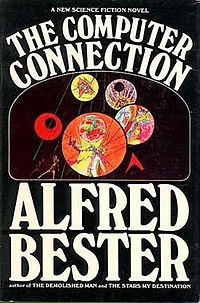
Review: The Computer Connection by Alfred Bester


The Computer Connection by Alfred Bester
Published : Berkley/Putnam, 1975
Awards Nominated : Hugo, Nebula, and Locus SF Awards

The Book :

”There is a Group of eccentric immortals, who have all come into being after a shocking near-death experience.  Some of them are actual historical celebrities, but others simply take on names that best describe their interests. Guig’s name comes from the “Grand Guignol”, and he earned it through his obsession with recruiting new immortals.  Unfortunately, it’s difficult to orchestrate an experience of horrific near-death followed by a miraculous save, so all his attempts have ended in failure.  Mostly, he just kills people in terrible ways—but with the best of intentions.

Guig has his sights set on a new recruit, a genius Cherokee scientist named Sequoya Guess.  The conversion marks Guig’s first success, but then something unexpected happens.  Guess has mysteriously formed a connection with a supercomputer known as the Extro.  Guess may want to further his research and make life better for humankind, but the Extro has more homicidal intentions.  Guig and his Group must face the terrible truth—if Guess can’t control the Extro, they may have to kill a man they think of as a brother.” ~Allie

This is my September novel for the Grand Master’s ReadingChallenge.  I picked this novel because I am generally a fan of Alfred Bester.  He is a skilled wordsmith, and everything he writes seems to be brimming with energy and enthusiasm.  While The Computer Connection was as ridiculous and energetic as usual, I don’t think it is one of his best novels.  For any newcomers to Bester’s work, I would recommend starting with some of his more well-known novels, such as The Demolished Man or The Stars My Destination.

My Thoughts

In the introduction to my edition of The Computer Connection, Harlan Ellison states that this novel is Alfred Bester’s take on a Hollywood screwball comedy.  I can see that idea at the heart of this novel, with its over-the-top characters and absurd situations.  The madcap energy that Bester seems to put into everything that he writes also works well to propel the story from one ridiculous event to the next.  The descriptions of communities and characters were all exaggerated and over-the-top, which fit well with the tone of the story. All the members of the Group had developed their niche—Nemo with his sea creatures, Herb Wells with his ‘time dingbat’, Borgia with her medicine, M’bantu with his wildlife, Sam Pepys with his historical records, and so on.  Their specializations influenced all of their interactions and made them easy to distinguish.

However, the exaggeration of these characters and their communities led to some wildly stereotypical portrayals of marginalized cultures.  On the up side, many of the main characters were non-white, and most of them were portrayed in a positive light.  For instance, Dr. Sequoya Guess was a world-famous Cherokee scientist, his sister Natoma was highly intelligent and assertive, and Fee-5 (a girl described as partially Maori) was also quite a marvel.  On the downside, the depiction of several cultures, most notably the Cherokee, was about as accurate and sensitive as Looney Tunes.  For instance, Dr. Guess lives in a teepee guarded by wolves, and Natoma is introduced through an accidental marriage (though the trope is somewhat subverted in the details). Guig also regularly calls Dr. Guess by nicknames like ‘Sitting Bull’, ‘Montezuma’, ‘Chief’, and so forth, though at least one character does explicitly call him out on this behavior.  In addition to this, Guig uses some slurs throughout the story (most notably one that is still often used against homosexuals), though he appears to do so without malice.  I think that these portrayals and inappropriate terms are meant to be seen as silly, but I can see how they could easily ruin the novel for many people. 

The story of The Computer Connection is fast-paced and entertaining, but not always entirely coherent. The science featured in the story doesn’t even try to be especially realistic, so one just has to accept the existence of ‘molecular men’, the bizarre results of Dr. Guess’s experiments, and more.  Quite a lot happens in the pages, and some of it seems a little unnecessary.  For instance, Fee-5 is a very interesting adolescent girl, but she ends up underutilized in the story.  Also, there is at least one plot twist late in the story that doesn’t seem relevant to much of anything.  It is foreshadowed, but it has no real connection to the plot or the characters.  Overall, it was a short, fun book, but the plot construction left something to be desired.

Regardless of the content of the story, however, I appreciated Bester’s use of language.  He used it here to build a vernacular for his future residents, and to add to add to the chaotic forward momentum of the story. In the anarchic land of future ‘Mexifornia’, most people speak a language composed of mangled English coupled with mangled Spanish, which somehow manages to be intelligible. In the Group, however, most people speak XX (20th Century English, I assume) which is peppered with easily decodable slang and shortening of words.  Bester’s slang felt very organic to me, particularly in this era of txtspk (Y/N?).  The language in The Computer Connection wasn’t quite as fun as, for example, the telepathic word pictures of The Demolished Man, but I always enjoy Bester’s creativity in his methods of communication and uses of words.

My Rating: 3.5/5

The Computer Connection is recognizably Alfred Bester’s style, but I don’t think it’s one of his best books.  His skill with language and his unstoppable energy shines through the pages, but the story does not reach the level of mastery that I remember from “The Demolished Man” or “The Stars My Destination”. The Computer Connection has been described as Bester’s take on a screwball comedy, and it is definitely full of over-the-top characters and absurd situations.  However, I was troubled by the stereotype-driven portrayals of various non-white cultures, particularly the Cherokee.  It was interesting to read a novel written later in Bester’s career, but I wouldn’t recommend it for a first taste of his work.

P.S. The cover I displayed in the 'upcoming reviews' was pretty terrible, so I found an older version to display here.

Tuesday, July 31, 2012

Review: The Night Sessions by Ken MacLeod


The Night Sessions by Ken MacLeod
Published : Orbit, 2008
Awards Won : British Science Fiction Association Award

The Book :

“After the devastation of the Faith Wars (or Oil Wars, as they are also called), the world went through what is known as the Great Rejection.  Now, religious faith is swept under the rug, and all officials are required to feign non-cognizance of any religious affiliation in the citizens they serve.  When a man dies in a bombing in Edinburgh, Detective Inspector Adam Ferguson suspects that the cause might be related to something he officially doesn’t know—the murdered man was a parish priest.

Ferguson pursues the case with his robotic partner, another legacy of the Faith Wars.  When the robotic war machine partners of human soldiers gained sentience, people suddenly saw them as highly dangerous.  Many of the self-aware robots, such as Ferguson’s partner, Skulk, were downloaded into the less threatening bodies of mini-War-of-the-Worlds tripod helper robots.  Others maintained their human form, and simply removed themselves from society.  Many moved up the space elevators into orbit, but hundreds continue to live in seclusion at a New Zealand creationist park, under the care of a robotics engineer and fundamentalist Christian, John Richard Campbell.  As robotic intelligence, faith, and violent crime collide, Ferguson searches for truth in a case that continues to grow ever more strange.” ~Allie

The Night Sessions was the novel I chose as a prize from WWEnd’s Grand Master Reading Challenge, which has been a lot of fun so far this year!  I’d never read any Ken MacLeod before, but I was intrigued by the premise—terrorism in a future with self-aware robots, and with religion almost completely removed from the public sphere.

My Thoughts :

The Night Sessions was a fairly quick read, and I wished that it could have been longer.  With its relatively short length, The Night Sessions tended to focus more on plot than on characterization or the details of the world building. There’s much to enjoy in MacLeod’s future world, but I felt as though I only got to see the parts that were absolutely necessary for the main plot.  For instance, the idea of sentient robots is obviously not a new one, but I enjoyed seeing how they were (or were not) integrated into society. Robots are very common in the world of The Night Sessions, but they were mostly only shown in their professional capacities.  For instance, Ferguon’s partner Skulk, was the most developed robotic character, but even he was rarely shown outside of the context of working on their case.  There’s not very much speculation on robotic psychology, or on how they might view their human creators, who only accept them if they are inferior and subservient.  There is an obvious parallel that could be drawn with Christianity here, but the novel doesn’t seem to travel far down that road.   

The basic plot is a detective story, but (thankfully) Ferguson is not the hotshot, failure, or alcoholic that I’m becoming used to seeing in these kinds of stories.  Instead, he’s just a pretty decent detective. He drinks moderately, is happily married, and sees his job as a job, not a validation of himself as a person.  However, he does have something of a dark past that is occasionally mentioned.  Apparently, in the past, the police actively persecuted churches and religious people. Ferguson regrets the brutality he took part in during those years, but the details of his past are left a little vague. Since I don’t know what acts he is guilty of having committed, it’s hard to judge whether he’s a decent cop who’s done a few bad things or a brutal cop who feels mildly ashamed of his worst excesses.  As a result, I was left with the impression that I did not understand the character of Ferguson very deeply.

Like Ferguson, most of the other characters were also lightly characterized.  Though they were developed only as far as was necessary for the plot, I still appreciated the different mindsets each character portrayed.  Religion (mostly Christianity) is a major factor in the story, and I liked that MacLeod showed some of the diversity of people of faith.  For instance, John Campbell is an extreme fundamentalist.  However, while he is occasionally infuriating, he’s not shown as a bad person. Another Christian character, Grace Mazvabo, was a fairly intelligent, religious professor. Of course, there are also strongly negative portrayals of religious faith, mostly of people who turn to violence on the basis of their beliefs.  An interesting added twist was the idea of robots finding religion, though I wish the mindset of religious robots could have been more thoroughly explored.   Altogether, there was quite a lot that I enjoyed about The Night Sessions, but I felt that a lot of interesting implications in the setting and characters were left unexplored.

My Rating : 3.5/5

I enjoyed reading The Night Sessions, but I was left wanting more.  I wanted to know more about the world MacLeod had begun to reveal and about the characters that I felt I only barely knew.  I liked how MacLeod showed the many different kinds of people—and robots!—who are drawn to religious faith, but I wish there could have been more of an exploration of what ideas lead robots or people toward faith in the first place.  The central mystery was interesting enough, but I would have loved to see more attention devoted to the many intriguing ideas that were barely referred to throughout the story. The world, its technology, and its issues were all very interesting, but I felt like the book was too short to explore any specific idea in great detail.