Showing posts with label Mystery. Show all posts

Sunday, September 8, 2019

Review: City of Blades by Robert Jackson Bennett

City of Blades by Robert Jackson Bennett
Published: Jo Fletcher Books/Broadway Books, 2016
Awards Nominated: Locus Fantasy Award

The Book:

“A generation ago, the city of Voortyashtan was the stronghold of the god of war and death, the birthplace of fearsome supernatural sentinels who killed and subjugated millions. Now, the city's god is dead. The city itself lies in ruins. And to its new military occupiers, the once-powerful capital is a wasteland of sectarian violence and bloody uprisings.
So it makes perfect sense that General Turyin Mulaghesh -- foul-mouthed hero of the battle of Bulikov, rumored war criminal, ally of an embattled Prime Minister -- has been exiled there to count down the days until she can draw her pension and be forgotten. At least, it makes the perfect cover story.
The truth is that the general has been pressed into service one last time, dispatched to investigate a discovery with the potential to change the world -- or destroy it. The trouble is that this old soldier isn't sure she's still got what it takes to be the hero.”  ~WWEnd.com
I didn’t really have much time to form expectations about this book, because I started it immediately after the first.  I was in an airplane, I had it on my e-reader, and the first book had been really good. There are some vague spoilers below, but I tried to keep from giving away specifics. I should also mention that this book was provided to me by Net Galley for Hugo considerations in 2018. I did read it for that purpose, though my review is considerably delayed.
My Thoughts:
City of Blades takes place a few years after City of Stairs, and it tells a standalone story. There are some recurring characters from the first book, but I think you could read them in whatever order you prefer. As in the previous book, I loved the cultural world-building and the atmospheric descriptions of place. The basic set up this time is similar, following a retired general traveling to Voortyashtan with the ulterior motive of investigating a strange disappearance.  Naturally, things are more complicated than they at first appear, and it soon becomes clear that deities might be involved somehow. The focus this time, though, is on the nature of war in general, and the effects of the specific war between Saypur and the continent. This makes for a somewhat darker book, and also one that I felt was more emotional. The brutality of Voortya’s people is still not far from the minds of Saypuri, and it is not surprising that peace there is a brittle thing.  On a more personal level, we see what war has done to the heroine, Turyin Mulaghesh.    
Mulaghesh was introduced originally in City of Stairs, but she didn’t make that much of an impression on me.  In this book, she takes center stage, and she became more compelling to me as I learned more about her.  She starts out as a particular character type, a veteran who isn’t coping well with the trauma of war and who has turned to alcohol for solace. However, she was not simply a soldier in the first war against the continent--she was an un-indicted war criminal.  The guilt that has been killing her since those days is justified. Her acceptance of her own sins also helps to keep her from romanticizing war and violence in the way that others might. I thought she made for an excellent protagonist for this kind of a story.  Fans of the first book might also be happy to hear that Sigrud plays a large supporting role, and that we do get to learn more about him. 
There’s one other thing I feel I should mention, since it happened both in City of Stairs and in City of Blades: a distressing and seemingly gratuitous character death.  There is a major side character in each book who is killed late in the story.  In both cases, this happened to a character I liked, and in both cases I didn’t see why it had to happen that way. This is more an issue of personal preference than a criticism of the book, but I thought it might be helpful to mention for other readers.  For me, it felt like a little unpleasant jab in a story where I would otherwise expect the major characters to save the day and emerge victorious. Aside from this small twinge, I found the story and the world to be as immersive and entertaining as ever.  
My Rating: 5/5
City of Blades, the follow-up to the impressive City of Stairs, tells a standalone story that is perhaps even more entertaining than the first novel.  Where the first novel focused on religion, culture, and history, this second novel focuses on war and its effects. For this purpose, rumored war criminal Mulaghesh is a natural protagonist.  Her personal story was emotional and compelling, and it matched nicely with the mystery she went to Voortyashtan to uncover. I am looking forward to seeing how the trilogy will conclude!

Saturday, August 31, 2019

Review: City of Stairs by Robert Jackson Bennett

City of Stairs by Robert Jackson Bennett
Published: Jo Fletcher Books/Broadway Books, 2014
Series: Book 1 of the Divine Cities
Awards Nominated: Holdstock, World Fantasy, and Locus Fantasy Awards

The Book:

“The city of Bulikov once wielded the powers of the gods to conquer the world, enslaving and brutalizing millions — until its divine protectors were killed. Now Bulikov has become just another colonial outpost of the world's new geopolitical power, but the surreal landscape of the city itself — first shaped, now shattered, by the thousands of miracles its guardians once worked upon it — stands as a constant, haunting reminder of its former supremacy.
Into this broken city steps Shara Thivani. Officially, the unassuming young woman is just another junior diplomat sent by Bulikov's oppressors. Unofficially, she is one of her country's most accomplished spies, dispatched to catch a murderer. But as Shara pursues the killer, she starts to suspect that the beings who ruled this terrible place may not be as dead as they seem — and that Bulikov's cruel reign may not yet be over.” ~WWend.com
I’d heard a lot of positive things about this series, so I finally decided to check it out.  I don’t think I’d ever read anything by Robert Jackson Bennett before. This review is going to be followed by one for City of Blades, because I read them back-to-back. I should also mention that this book was provided to me by Net Galley for Hugo considerations in 2018. I did read it for that purpose, though my review is considerably delayed.
My Thoughts:
Part of the reason I held off on reading this for several years, despite hearing positive things about it, is that it appeared to be an epic fantasy revolving around a murder mystery.  I have a low tolerance for murder mysteries, and my interest in epic fantasy had been flagging. Luckily, this book was unusual in both of these respects. The story does start off with a murder investigation, but the death is more of an inciting incident than the central focus of the story.  The world is also really creative, and has more technology than I would usually expect in the sub-genre. The sense of place for Bulikov is very strong, and I enjoyed the way the unreliable, frightening effects of the divine influenced the story. I also appreciated the complicated cultural tension between Saypur and the continent.  The way the world was described made the book feel very immersive to me, so I was very quick to be drawn into the story.
This is a plot-driven book, rather than character-driven, but several of the characters were quite memorable.  I like reading about teamwork, so I was a big fan of the strong non-romantic relationship between Shara and Sigrud.  They complemented each other well and made for a nearly unstoppable team. There was a little too much of an emphasis on quirks in their characterization for me (e.g. Shara constantly drinks tea and doesn’t eat), but that’s a minor complaint.  It was really easy for me to latch onto Shara’s perspective let myself be swept away by the story. Sometimes coincidences she encountered seemed a little convenient, but I was always eager to see the next new thing. This was a smooth read that felt far shorter than its 400+ pages. I was ready to read the next book of the series immediately!
My Rating: 4.5/5
City of Stairs is a highly entertaining fantasy story that kicks off with a murder mystery and ends up with much more miraculous problems.  I especially liked the world-building and the immersive atmosphere of the setting. The non-romantic partnership of the main characters, Shara and Sigrud, was also a strong draw for me.  They were both memorable characters in their own right, but together they made for a compelling team. There was a lot going on throughout the book, but everything came together in a satisfying way at the end.  I’m certainly going to be reading more work by Bennett, and I’ll be reviewing City of Blades next on my blog!  

Thursday, October 25, 2018

Review: Lock-In by John Scalzi

Lock In by John Scalzi
Published: Tor, 2014
Series: Book 1 of the Lock In Series
Awards Nominated: Campbell Award & Locus SF Awards

The Book:

“Fifteen years from now, a new virus sweeps the globe. 95% of those afflicted experience nothing worse than fever and headaches. Four percent suffer acute meningitis, creating the largest medical crisis in history. And one percent find themselves "locked in"--fully awake and aware, but unable to move or respond to stimulus. One percent doesn't seem like a lot. But in the United States, that's 1.7 million people "locked in"... including the President's wife and daughter.

Spurred by grief and the sheer magnitude of the suffering, America undertakes a massive scientific initiative. Nothing can restore the ability to control their own bodies to the locked in. But then two new technologies emerge. One is a virtual-reality environment, "The Agora," in which the locked-in can interact with other humans, both locked-in and not.

The other is the discovery that a few rare individuals have brains that are receptive to being controlled by others, meaning that from time to time, those who are locked in can "ride" these people and use their bodies as if they were their own. This skill is quickly regulated, licensed, bonded, and controlled. Nothing can go wrong. Certainly nobody would be tempted to misuse it, for murder, for political power, or worse....”~WWEnd.com

I read this one while traveling for job-hunting, and it was the perfect choice for that slice of my life--interesting, entertaining, and not emotionally distressing.  I have a signed copy of Head On, the sequel to Lock In, and I’m planning to read it sometime soon.

My Review: 3.5/5

The central science fiction element of the story is the new virus that causes the “locked in” crisis, and it was interesting to see how society might adapt to handle this kind of a problem. On the accommodations side, the Agora makes sense and it was cute that the robotic proxies were named after C-3PO. The ability to control another human, which is an issue at the heart of this murder mystery, clearly carries the potential for abuse. I enjoyed seeing how the illness and related accommodations had become mundane, everyday reality, and how the new technology was used to make daily tasks simpler.  At the point of the story, being locked in is no longer a nightmare, but just ordinary reality for a group of people with distinct social and political needs.

The new technology also adds complications to figuring out the murder mystery.  It’s clear whose bodies were at the scene of the crime, but who was inhabiting them at the time and for what purpose?  I didn’t figure out the answer in advance, so it was fun to see how everything fit together. This is primarily a procedural case story, though, so it is also a rather light book.  The mystery was more engaging than the characters (though I liked them just fine), and the world-building was important inasmuch as it was important to the case. Sometimes that’s exactly the kind of story you want, though, and I am looking forward to reading about Agent Chris and Leslie’s next case.

Saturday, July 19, 2014

Review: Jack Glass by Adam Roberts

Jack Glass by Adam Roberts
Published: Gollancz, 2012
Awards Won: Campbell Award and British Science Fiction Association Award

The Book:

“Murder has been committed, and Jack Glass is guilty—that much is certain.  But what exactly has he done? How? Why?  These are the more interesting questions. In a future world where trillions of expendable humans live in fragile bubbles in space, even the rumor of faster than light travel is enough to cast the power structures of the world into disarray—and to cause several very unusual murders.

A series of three mysteries form the backbone of this story, and each one of them is impossible in its own way. These three mysteries include: a need to escape from an isolated prison asteroid, a murder that conveniently occurs for a wealthy girl detective’s birthday, and a gun that seems to have shot in the wrong direction. When something is impossible, though, it usually just means that you’re overlooking a crucial detail.” ~Allie  

I’ve been meaning to check out Adam Roberts’s work for a while, but for the longest time, his work wasn’t published in e-book format (or, sometimes, outside the UK). I’ve already bought Jack Glass and By Light Alone in physical form, but it looks like his work has become more easily available (as e-books) since then! I expect that I will read more of his novels in the future.


My Thoughts:

Jack Glass was an incredibly entertaining mystery science-fiction novel, with an enthusiastic style of narration and mysteries that seemed to invite reader speculation.  Rather than just trying to figure out ‘whodunit’ (that much was given), the challenge was to figure out all the intricacies of the situation before they were revealed.  I think that sufficient clues were given in most situations, such that figuring it out was possible, though sometimes challenging. The science aspects were sometimes a bit sketchy, but I was willing to overlook that in order to enjoy the story.  I often found myself pausing in my reading, to sort out what I thought the explanations would be.  I definitely missed some details, but, happily, the solutions are also given within the novel!  It was really fun to see what I had right, and what I’d overlooked.

Beneath the fun of solving the mysteries, though, Jack Glass slowly shows a pretty dark, pessimistic future.  Trillions of humans live on the edge of death in fragile slum bubbles, and the luckiest of these are heavily drugged in order to become ultra-loyal servants of the wealthy.  The solar system is a cold place, governed by power politics and profit, and human beings are seen as a cheap, renewable resource. In such a world, and especially in a murder story, it should come as no surprise that there’s some fairly gruesome violence and references to sexual assault.  Most of the more disturbing violence occurs within the first third of the novel, in which Jac is trapped for an 11-year sentence in an asteroid with a group of convicts. In the later parts of the story, though, I think the liveliness of the story tends to balance the grimness of the setting.

A lot of that liveliness comes from the voices of the characters through which we experience the story—who are, surprisingly, not Jack Glass, though he is often present.  This includes the unnamed (until later) narrator, who is ‘doctorwatson’-ing the story for our benefit, who has an engaging voice, and the wealthy, young detective, Diana Argent.  While the middle section is in Diana Argent’s voice, it still seems to be written by the unnamed narrator. Diana Argent is an extremely wealthy young girl, who has been raised as a data analyzer, and who specializes in people.  She has therefore developed a deep interest in murder mysteries, and it is her very own “birthday” murder mystery that leads into the larger story. Her voice is full of enthusiastic slang (“No wavy way!”), a good portion of which she probably doesn’t even understand (“That’s close enough for government work.”).  The minor characters in the story seem only very lightly characterized, but Diana, Jack, and the unnamed narrator are more than sufficient to bring life to the mysteries they encounter.

My Rating: 4/5

Jack Glass was an extremely fun mystery science fiction story, set in a surprisingly depressing future scenario for the solar system.  I really enjoyed trying to work out the details of each of the three ‘murder mystery’ situations before the answers were revealed, though I was not 100% successful.  The main story involved the social effects of the rumor of the possibility of faster-than-light travel, in a society governed by politics and profit, where the vast majority of people live in extreme poverty. The distinctive, enthusiastic narrative voice, especially in the second section, helped to give a lively feeling to the story, despite the grim setting.  Overall, Jack Glass was an entertaining novel, and I plan to read more of Roberts’s novels in the future.      

Monday, May 26, 2014

Review: The Islanders, by Christopher Priest

The Islanders by Christopher Priest
Published : Gollancz, 2011
Awards Won : BSFA Award and Campbell Memorial Award

The Book :

“A tale of murder, artistic rivalry, and literary trickery; a Chinese puzzle of a novel where nothing is quite what it seems; a narrator whose agenda is artful and subtle; a narrative that pulls you in and plays an elegant game with you.

The Dream Archipelago is a vast network of islands. The names of the islands are different depending on who you talk to, their very locations seem to twist and shift. Some islands have been sculpted into vast musical instruments, others are home to lethal creatures, others the playground for high society. Hot winds blow across the archipelago and a war fought between two distant continents is played out across its waters. 

The Islanders serves both as an untrustworthy but enticing guide to the islands; an intriguing, multi-layered tale of a murder; and the suspect legacy of its appealing but definitely untrustworthy narrator.” ~WWEnd.com

This is only the second novel I’ve read by Christopher Priest, and the first was The Prestige.  I really enjoyed both the book and film of The Prestige, though they had their differences.  I’d always meant to read more of his work.

My Thoughts:

The Islanders is presented as a guide to the Dream Archipelago, and it contains chapters describing various islands, ordered alphabetically. The Dream Archipelago is an uncertain, contradictory kind of place, and the structure of the novel reflects that.  It is a place that can’t be seen as a whole, due to temporal distortions, and so, like the reader, the inhabitants have to build a sense of their world from experiences and disjointed information. Many pieces of the puzzle are also suspect or inconsistent.  For example, this is a book whose fictional introduction is written by a character that dies within its pages. Since I haven’t read many of Christopher Priest’s novels, I’m not sure exactly where this novel fits into his larger body of work.  There are other works that feature the Dream Archipelago, but I didn’t feel like I was missing anything crucial by reading The Islanders first.


The novel makes for a very odd kind of travel guide, since the information provided for each island varies greatly.  Some islands’ sections contain only geographical and cultural descriptions, others have complete short stories, and still others contain transcripts of interviews or correspondences.  Some chapters, like the one about the horrific insects named thrymes, were pretty exciting in their own right, but I was most impressed by how the different sections interlinked with one another.  For instance, one section contained a one-sided conversation of letters between an aspiring novelist and a famous writer Chaster Kammeston.  Though her letters seem perfectly friendly and polite, information later revealed about Kammeston highlights how many of his buttons she managed to innocently push.  I loved how the book became progressively more complicated as there was more information to mentally cross-reference, and I spent a lot of time flipping back and forth between chapters to remind myself of small details.

The novel offers many tantalizing puzzles, but it does not provide any solutions.  If you’re expecting any kind of resolution or conclusion resolves the mysteries and ties together the different plotlines, then you will be disappointed.  There are enough clues, though, for the reader to come up with their own theories, and it is also left to the reader to decide on what meaning, if any, the overall work holds. For one example, there is never any revelation about the true circumstances of the murder, mentioned in the novel’s description. However, there’s enough information scattered throughout the novel to give a pretty good idea of what happened.  I can see how this style of novel would not be to everyone’s taste, but I had a lot of fun trying to see how everything fit together!  

My Rating: 4/5


The Islanders is more of a puzzle than a conventional novel.  It is presented as a tourist’s guide to the Dream Archipelago, and it contains a story, description, correspondence, or other shortwork for a variety of islands, ordered alphabetically by name.  I liked how the various sections linked to one another, and how information gained later in the novel could change the interpretation of previous chapters.  I thought it was a lot of fun piecing larger stories together from the information scattered throughout the different islands’ sections.  There is really nothing in the way of a conclusion, though, so the larger picture only exists within the readers’ minds.  Like the cartographers that draw maps from the Archipelago’s wandering drones, the reader is left to construct their view of The Islanders by building connections between many disjointed pieces of information.   

Tuesday, December 6, 2011

Review: Seeker by Jack McDevitt

Seeker by Jack McDevitt
Published: Ace Books, 2005
Series: Book 3 of the Alex Benedict Series
Awards Won: Nebula
Awards Nominated: John W. Campbell Award

The Book:

"Thousands of years after an entire colony mysteriously disappears, antiquities dealer Alex Benedict comes into possession of a cup that seems to be from the Seeker, one of the colony's ships. Investigating the provenance of the cup, Alex and his assistant Chase follow a deadly trail to the Seeker-strangely adrift in a system barren of habitable worlds. But their discovery raises more questions than it answers, drawing Alex and Chase into the very heart of danger." ~barnesandnoble.com

Seeker is the third Alex Benedict novel, but I get the sense that this series is mostly episodic.  I haven't read anything by McDevitt before, but I don't believe that any prior reading is required to enjoy Seeker.

My Thoughts:

Seeker is a treasure-hunt detective story set in a star-spanning far-future human civilization.  The two main characters--the brilliant detective Alex Benedict and the narrator, his assistant Chase Kolpath--seemed like sci-fi versions of traditional 'Sherlock' and 'Watson' characters.  The book focused mostly on Chase and her legwork in the hunt for the lost colony, but Alex also turned up fairly often.   I enjoyed following Chase, as she interviewed disparate people and traveled to exotic locations.  However, while the characters Chase came into contact with had very clearly defined personalities, I didn't feel like they had much depth or three-dimensionality.  Overall, Seeker is driven much more by the plot concerning the central mystery than by character motivations.

The story felt very formulaic, but that's not to say it wasn't entertaining.  I was intrigued by the mystery of the Seeker and the search for what became of the lost colony.  The uncovering of the mystery was leisurely-paced and somewhat predictable, but I enjoyed reading about Chase's gradual accumulation of information and her and Alex's developing hypotheses.  The major subplot of the novel concerned a mysterious force that seemed determined to stop--or eliminate-- Alex and Chase.  I thought this storyline felt a bit forced, as if it were added after the fact to generate more physical conflict.  The final resolution of the subplot was underwhelming, and seemed like something I might have expected from a generic thriller or action film.

Given that it was set about 10,000 years in the future, I was also bothered by the similarity of Seeker's human culture to modern America.  From slang, to daily habits, to food and drink, to general social and political attitudes, to socio-economic classes, to character archetypes, it all felt a little too familiar.  It seems like there would be some major shifts in attitudes and societal structure in that much time.  However, I don't mean to imply that the world-building has nothing to offer.  There are a few interesting technological developments and an interesting alien race, the Mutes, that briefly intersect the story.  All the same, the characters seemed like they would feel at home in the U.S. of 2011, which was a little jarring for such a far-future, deep-space society.

My Rating: 3/5


Seeker doesn't break any molds, but it's still an entertaining novel.  The leisurely-paced, intriguing mystery of the lost colony is woven together with a clichéd, thriller-like action subplot.  The characters were serviceable for the story, but they weren't ultimately memorable outside of their roles in the investigation.  It was sometimes difficult to maintain my suspension of disbelief, since McDevitt's millennia-old space culture was strikingly similar to early 2000s United States.  Even with these complaints, I did enjoy Seeker.  It may not be groundbreaking, but I think reading a book like Seeker is a pleasant way to spend a lazy afternoon.

Friday, April 22, 2011

Review: Four and Twenty Blackbirds by Cherie Priest


Four and Twenty Blackbirds by Cherie Priest
Published: Tor Books (2005)
Series: Book 1 of the Eden Moore Series
The Book:
“Although she was orphaned at birth, Eden Moore is never alone. Three dead women watch from the shadows, bound to protect her from harm. But in the woods a gunman waits, convinced that Eden is destined to follow her wicked great-grandfather--an African magician with the power to curse the living and raise the dead.

Now Eden must decipher the secret of the ghostly trio before a new enemy more dangerous than the fanatical assassin destroys what is left of her family. She will sift through lies in a Georgian ante-bellum mansion and climb through the haunted ruins of a 19th century hospital, desperately seeking the truth that will save her beloved aunt from the curse that threatens her life.” ~from GoodReads

I’m reading Four and Twenty Blackbirds as a part of the 2011 Women in Fantasy Book Club.  I’ve never read anything by Cherie Priest before, so this novel, her first, seems like a great place to start. It's the first book of a series, but this Southern Gothic dark fantasy certainly stands on its own.
My Thoughts:
Cherie Priest has an impressive talent in describing scenery and generating an atmosphere.   Chattanooga is not too far off from my own home, and Priest evoked the sense of the area so clearly that it left me desperately homesick.  Whether she’s describing an ancient Georgian mansion, a sweltering swamp, or a local library, the place feels so lifelike that I can close my eyes and almost imagine I’m there.   Her skill with creating atmosphere shows in the many scenes with palpable tension and/or a strong sense of unease.  It is the manipulation of tension that seems to shift this novel more towards horror.  I’m a total coward, so I started reading only during the day after a particular scene from Eden’s youth kept me awake for a few hours one night.
The story is written in first person, but Eden’s a pretty sympathetic narrator.  She’s a physically tough, intelligent, biracial woman brimming with self-confidence.  While she does occasionally come off as a little too arrogant and unfeeling, I always got the sense that Eden-the-narrator uncomfortably acknowledges that she’s being a bit of a jerk.  Besides, I think her emotional shell is probably a pretty realistic development for a biracial girl growing up in the South.  Overall, Eden is a strong heroine whose personality makes the story even more engaging.
While the scenery, atmosphere, and characters are pretty awesome, I had a few minor complaints with the way the story unfolded.  Though I enjoyed learning more about Eden through the short stories from her childhood that opened the novel, they seemed almost beside the point in the context of the overall story.  I felt like many of those scenes could have been removed completely without altering the structure of the story at all.   As a result, the story seemed to wander aimlessly from short story to short story until Eden grew up and the main plot kicked in.  The childhood scenes were certainly well written and entertaining, but I wish they’d been more relevant to the rest of the book.
After the main mystery of the novel got started, I was a little bothered by how easy everything seemed.  For instance, Eden wants to find someone who doesn’t want to be found, so she looks her up in a phone book.  The first and only name Eden finds is the woman she’s seeking, and it even gives her address.  I don’t know about you, but if I wanted to vanish, I’d go unlisted.  At the very least, I wouldn’t list my address.  In the same way, basically every action Eden takes leads her closer to the resolution of the mystery.  She never seems to make any false steps, even when she’s just acting on a whim.  To its credit, though, the central mystery was pretty complicated and required a fair bit of unraveling, even with Eden’s amazing luck. 
There were a few other little things throughout the book that I found slightly annoying.  For example, the story seems to be set in 2005, but Eden doesn’t use cell phones or the Internet.  It’s implied later on that Eden’s kind of anti-technology, but the lack of modern gadgets really gave the book a 1990s feel to me.  Also, the villainous characters seemed a bit more cookie-cutter than I would have liked.  There was a homicidal religious fanatic that just wouldn’t die, a racist old rich lady, and a supernatural main villain that was pretty much pure evil.  The fanatic and the racist were somewhat more developed as characters than the evil magician, who I wish could have been a little less of a standard villain.
My Rating: 4/5
Altogether, Four and Twenty Blackbirds shaped up to be an entertaining book, and it establishes Cherie Priest in my mind as a writer whose work I will most likely enjoy reading.  The strong heroine, vivid locales, and complex plot definitely outweighed my gripes about the story’s construction and the mostly-flat villains. I don’t typically read many novels that lean this close to horror.  If you're like me, I’d recommend not reading Four and Twenty Blackbirds alone in an old apartment in the middle of the night.  I am curious to see where Eden’s story will go from here, but I think I might try out one of Cherie Priest’s steampunk novels before I continue the Eden Moore series.

Thursday, February 17, 2011

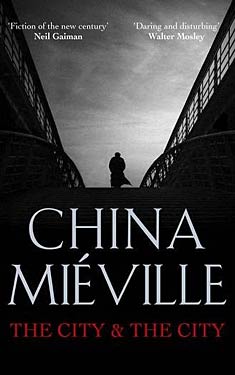
Review: The City & The City by China Miéville


The City & The City by China Miéville
Published: Del Rey, 2009
Awards Won: Hugo, Arthur C. Clarke, World Fantasy, British Science Fiction Association, Locus Fantasy
Nominated: Nebula, John W. Campbell Memorial


This is the first book I’ve read by China Miéville.  As you can see by the genre split in the awards, this book is difficult to classify.  When one examines the plot, The City and the City is a detective story.  The protagonist is Inspector Tyador Borlú, and the story follows his investigation of the murder of a young female student, Mahalia Geary.  Solving the case is more complicated than it first appears, and Borlú must deal with both conspiracy theories and the odd difficulties caused by nature of his environment. It is the setting that pushes the story past the realm of a simple murder mystery and into the bounds of speculative, or at least weird, fiction. 

Tyador Borlú lives in Besźel, which seems to be somewhere in Eastern Europe.  What sets Besźel apart from our usual world is its partner city, Ul Qoma.  These two cities have some separate zones and some “cross-hatched” areas, where their land overlaps.  All that truly separates Ul Qoma and Besźel are the perceptions of their respective citizens.  People who live in Besźel are taught from birth to ignore, or “unsee”, anything or anyone in Ul Qoma, and vice versa. To help people always be able to recognize and ignore the foreign, Besźel and Ul Qoma have different architecture, fashion, and even mannerisms.   In some cases, however, this separation is accidentally or deliberately violated. In this case, the mysterious organization called “Breach” swoops down to take control. 
It is between the physical, cultural, and political cities of Besźel and of Ul Qoma that Tyador Borlú must navigate as he searches for the truth behind Mahalia’s murder.  It is possible that she knew something about a mythical third city, “in between the city and the city”, called Orciny.  Her murder leads Borlú deeper and deeper into the connections between Besźel, Ul Qoma, Breach, and Orciny.

My Thoughts:

I found myself taking the viewpoint of a typical foreigner, as described by Borlú.  I had a hard time accepting the separation between Ul Qoma and Besźel.  The whole book was written with a sense of realism and detail, and everything, except the basic premise of the dual city, seemed reasonable.  I’m doubtful that any human organization could possibly police every action and glance of every citizen, as Breach is purported to do.  In order to be sustainable, it seems that the system would need the wholehearted support of every citizen of Besźel and Ul Qoma.  Given my experience of people, in general, I find this very unlikely.

Why would people support this kind of mass doublethink in the first place?  Other than Besźel and Ul Qoma, the world seems to be pretty much the same as our modern world.  In our world, there does not seem to be such a shortage of land that people would be forced to “cross-hatch” their territories.  Was it simply a matter of two ethnic groups claiming the same land?  They would have had to hate each other enough to eliminate interaction through creating these mental borders, but tolerate each other enough to willingly share the same physical territory. 

There just doesn’t seem to be a logical basis for the origination of these cities, nor for the capabilities of the Breach organization.  The dissonance between the realistic style of prose and the impossible elements of the story overshadowed, for me, the actual plot.  I can only think that these elements exist deliberately. The City and the City is a traditional murder mystery whose setting juxtaposes the ordinary with the impossible, and smudges the lines between what is real and what is not.

My Rating: 4/5 Stars

I was much more enthralled by the setting than the plot or characters.  In the end, though, the setting was more than bizarre enough to keep me entertained.  I’m glad I read this book, and I will probably read his New Crobuzon series at some point in the future.