Monday, October 8, 2012

Review: Eon by Alison Goodman


Eon by Alison Goodman
Published: Firebird Distributing, 2010
Series: Book 1 of the Empire of Celestial Dragons Duology

The Book:

“In the Empire of Celestial Dragons, the twelve Dragoneyes stand below only the Imperial Family in power and prestige.  A Dragoneyes sacrifices his own life energy, “Hua”, in a bond with one of the twelve energy dragons of the zodiac. In return, he gains great power to protect the realm, which is increased further in the year that his dragon is ascendant.  Currently, there are only eleven Dragoneyes, since the Dragon-Dragon (known as the Mirror Dragon) has been missing for hundreds of years.  This year, a fresh crop of potential apprentices will present themselves to the ascendant Rat Dragon.

Sixteen-year-old Eon is one of those candidates.  Eon’s master, a former Dragoneye, has gambled the last of his fortune to put forth Eon as a candidate.  If Eon is selected, it could return the former Dragoneye to a wealthy and powerful position. He hopes that Eon’s incredibly rare spirit sight might serve to attract the dragon.  However, Eon has two marks against her from the beginning—she has a crippled leg and she is truly a woman named Eona.  While the first condition is viewed disfavorably, the second is entirely unacceptable.  If anyone discovers Eon’s true gender, she knows she will probably be killed.” 

I read this novel for Calico Reaction’s Theme Park Reading Challenge.  Eon, which is written by Alison Goodman from Melbourne, Australia, was picked for the theme “Aussie YA”.  Eon is the first half of a duology, the second book of which is titled Eona. Eon, which ends on a cliffhanger, is clearly the first half of a larger story, but it also has its own arc that does come to a satisfactory close, in my opinion.  The first book has also been released as The Two Pearls of Wisdom, Eon: Dragoneye Reborn, and Eon: Rise of the Dragoneye, but I will refer to it simply as Eon throughout the review.

My Thoughts:

As far as plot goes, Eon is a pretty predictable YA fantasy.  It features a female main character who is forced to hide her gender in order to succeed. While there is almost no romance to speak of in this novel, the groundwork appears to be laid for love to blossom in the second.  The good guys are good, the bad guys are very bad, and there is very little in the way of moral ambiguity. In general, the plot points were pretty easy to see coming, and heavy foreshadowing gave away anything that was not immediately obvious. Just because there is nothing unexpected, though, doesn’t mean the story wasn’t entertaining.  I thought it was well-paced, with a good ratio of description and world-building to plot, and reading the novel was usually a pleasant part of my day.    

In addition to the predictable plot, the main character, Eon, came very close to being too clichéd for me to appreciate.  She has convenient amnesia concerning parts of her early life, and she is gifted with exceptional spirit sight, as well as several other things throughout the story. The predictability of the novel also had an unfortunate effect on the portrayal of Eon.  The solution to the central mystery is fairly clear to the reader from near the beginning, but it takes Eon much, much longer to figure it out.  Even considering that her ingrained prejudices may have clouded her thinking, this seemed to paint her as more than a little unintelligent.  Even though Eon grated on me sometimes, though, I still appreciated some things Goodman did with her character.

 One of the more interesting points of the novel was the way the characters were used to discuss gender identity.  The most notable in this regard were Eon and Lady Dela, both characters who presented a gender that did not match their biological sex.  Eon honestly believed that women were inferior to men, and so she desperately tried to suppress everything about herself that was feminine.  Even aside from the threat of execution, I think that Eon wanted to believe she had a ‘male’ spirit, so that she could be worth more in her own eyes.  Contrasted with this unhealthy attitude of gender was the transsexual Lady Dela, a force to be reckoned with in the imperial court.  She encountered many hardships by living as a woman, but she insisted that was the only way she could live and be true to herself. Through her acquaintance with Lady Dela and others, Eon is forced to engage with her own problematic ideas about sex and gender.

Another strength of the novel was its setting.  Rather than the usual pseudo-medieval European influences, Goodman’s fantasy empire took influences from several Asian cultures, mostly Chinese and Japanese.   The Empire of Celestial Dragons was obviously not a representation of any actual culture, but Goodman used many details from reality to construct a fantasy culture that felt pretty well thought out and respectful.  The story was mostly set in a small area, the imperial palace complex, and the descriptions throughout the story build it up to a delightfully detailed picture.   

My Rating: 3.5/5

Eon is a predictable YA fantasy that covers very familiar ground, but it is fairly well-constructed and entertaining.  I particularly liked the culture of the fantasy Empire, which draws influence from Asian cultures.  The story was told in the relatively small stage, mostly the imperial palace complex, and that area was very vividly described.  Though the main character, Eon, seemed at times to be annoyingly dense, I liked the gender issues that were explored through her character. I was occasionally bothered by clichés and the predictability of the plot, but I still enjoyed Eon and am planning on reading the second half of the story.

Thursday, September 27, 2012

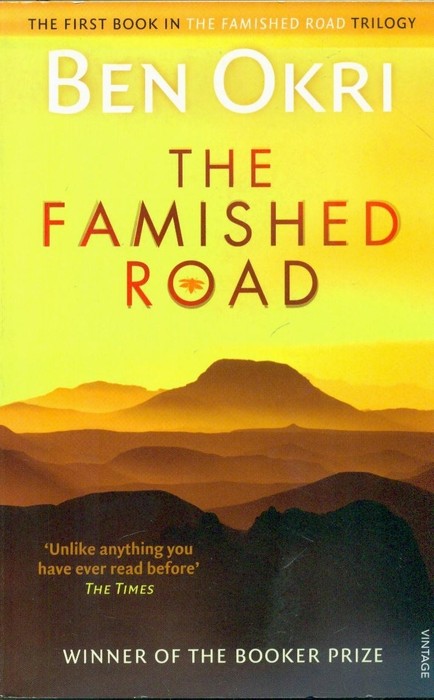
Review: The Famished Road by Ben Okri


The Famished Road by Ben Okri
Published : Jonathan Cape, 1991
Series : Book 1 in the Abiku Trilogy
Awards : Man Booker Prize

The Book :

"Our country is an abiku country. Like the spirit-child, it keeps coming and going. One day it will decide to remain." ~p.478 The Famished Road

“Azaro is an abiku, a spirit child that does not want to be born.  Abiku make pacts with their spirit companions to not leave the perfect happiness of the spirit world for the difficulty and sorrow of a mortal life.  When an abiku is forced to be born, he typically returns to the spirit world as soon as possible.  Azaro, however, chose to stay, in order to bring happiness to the woman that would be his mother.

Though his spirit companions call to him, though the road he sees ahead of him is a thankless, painful struggle, he continues to refuse to abandon his mortal life.  Azaro lives his life of hardship with his loving parents in a poor Nigerian community.  Caught between life and death, Azaro has a connection to the spirit world, and the spirits plague his life as surely as the more mundane problems of hunger, violence, and political corruption.” ~Allie

 I read this novel as a part of the Outside the Norm reading group at WWEnd.com.  As a result, a lot of this review is informed by this discussion (beware of spoilers).  I’ve never read anything by Okri before, and this was honestly nothing like what I expected. As a random side note, apparently the Radiohead song“Street Spirit (Fade Out)” was inspired by TheFamished Road. 

My Thoughts:

I haven’t had all that much experience with magical realism, so I wasn’t entirely sure what to expect from Okri’s novel.  The supernatural elements, which could be better termed the spiritual elements, were seamlessly intertwined with reality.  The spiritual content seemed to follow an animist tradition, and it mostly involved visions and spiritual journeys.  For example, Azaro often had visions of various spirits, and they sometimes even physically interacted with him.  Also, whenever anyone became sick, their loved ones went to great lengths to lure the soul back from the land of spirits into its physical body.  Both Azaro’s visions and the spirit journeys of the sick and dying were treated as if they were a normal and natural part of life.  Sometimes, the interpretations of these spiritual experiences were relatively clear, but at other times I felt like some deeper meaning was eluding me.  While the spiritual segments were often very poetically written, I couldn’t always see the relevance to the story.  I feel like this might be a novel that would benefit from more extensive study.  

I was equal parts impressed and frustrated by the protagonist, the young child Azaro.  He seemed very realistic as a child, and early in the novel he simply observed most of his world with little understanding or interpretation. He had very little power to influence or change much in his life. Like many children, he also rarely reflected on his own actions, and would often simply answer the questions of adults with, “I don’t know.”  In terms of the narrative, though, having such an incommunicative, powerless protagonist began to grate after a while.  I had hoped that he would grow throughout the book and become a more active participant in his society.  While he does age up from infancy to around 10-12 years of age, he never really loses his childlike passivity.  

Most of what Azaro provided was a highly detailed view into a poverty-stricken community in post-colonial Nigeria. The physical elements of his world, such as the nearby forest, Azaro’s family’s small, rat-infested apartment, and the local bar were brought to painful life through Okri’s descriptive prose.  Even more, though, the myriad people of the community were shown clearly, with all their dreams, hopes, and flaws.  Azaro’s father dreams big but plans poorly, throwing his money into parties and alcohol.  His mother works desperately hard, but can’t help the creeping despair that her life will never be what she once imagined.  The local bar owner, Madame Koto, aspired to material success above all things, though she was not as single-minded as her legend might make one believe.  On a larger scale, Azaro saw how the people of his community behaved en masse, how they were manipulated by corrupt politics, how they were divided by petty feuds, and how they felt that their little corner of the world didn’t really matter at all to those outside.  I found it to be a stunningly vivid portrayal of poverty and the way people coped with their lives.

While the writing was beautiful, and the setting and characters were complex and fascinating, the actual plot was frustratingly non-traditional.  The story never appeared to be leading anywhere, or building up to any kind of major event.  It simply continued, as Azaro’s life and his family and friends’ lives did.  The narrative was very cyclical, and even repetitive, portraying people facing an endless series of small successes and failures that left them in essentially the same place.  While I realize this was the point, the absence of direction in the plot left the story feeling like something of a slog. As a representation of the ideas embedded in the novel, however, the structure of the story makes a lot of sense.

My Rating : 4/5

The Famished Road, is an impressive work of literature.  The novel gave a very thorough look at Azaro’s poor Nigerian community, and the animist-style spiritual elements were integrated seamlessly into his reality.  It was interesting to see a story written from a child’s perspective, but the limitations that placed on Azaro’s ability to fully engage with his world in an active way were frustrating.  The lack of a traditional plot sometimes made reading feel like a trudge.  One of the central ideas was the never-ending struggle that defined life, and this was shown by the cyclical, repetitive stories of daily successes and failures that constituted the novel.  While I can see why this work of magical realism has many fans, I don't think it will become one of my favorites.

Friday, September 21, 2012

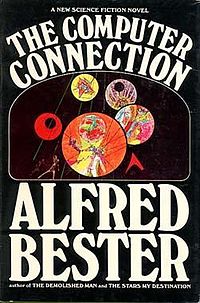
Review: The Computer Connection by Alfred Bester


The Computer Connection by Alfred Bester
Published : Berkley/Putnam, 1975
Awards Nominated : Hugo, Nebula, and Locus SF Awards

The Book :

”There is a Group of eccentric immortals, who have all come into being after a shocking near-death experience.  Some of them are actual historical celebrities, but others simply take on names that best describe their interests. Guig’s name comes from the “Grand Guignol”, and he earned it through his obsession with recruiting new immortals.  Unfortunately, it’s difficult to orchestrate an experience of horrific near-death followed by a miraculous save, so all his attempts have ended in failure.  Mostly, he just kills people in terrible ways—but with the best of intentions.

Guig has his sights set on a new recruit, a genius Cherokee scientist named Sequoya Guess.  The conversion marks Guig’s first success, but then something unexpected happens.  Guess has mysteriously formed a connection with a supercomputer known as the Extro.  Guess may want to further his research and make life better for humankind, but the Extro has more homicidal intentions.  Guig and his Group must face the terrible truth—if Guess can’t control the Extro, they may have to kill a man they think of as a brother.” ~Allie

This is my September novel for the Grand Master’s ReadingChallenge.  I picked this novel because I am generally a fan of Alfred Bester.  He is a skilled wordsmith, and everything he writes seems to be brimming with energy and enthusiasm.  While The Computer Connection was as ridiculous and energetic as usual, I don’t think it is one of his best novels.  For any newcomers to Bester’s work, I would recommend starting with some of his more well-known novels, such as The Demolished Man or The Stars My Destination.

My Thoughts

In the introduction to my edition of The Computer Connection, Harlan Ellison states that this novel is Alfred Bester’s take on a Hollywood screwball comedy.  I can see that idea at the heart of this novel, with its over-the-top characters and absurd situations.  The madcap energy that Bester seems to put into everything that he writes also works well to propel the story from one ridiculous event to the next.  The descriptions of communities and characters were all exaggerated and over-the-top, which fit well with the tone of the story. All the members of the Group had developed their niche—Nemo with his sea creatures, Herb Wells with his ‘time dingbat’, Borgia with her medicine, M’bantu with his wildlife, Sam Pepys with his historical records, and so on.  Their specializations influenced all of their interactions and made them easy to distinguish.

However, the exaggeration of these characters and their communities led to some wildly stereotypical portrayals of marginalized cultures.  On the up side, many of the main characters were non-white, and most of them were portrayed in a positive light.  For instance, Dr. Sequoya Guess was a world-famous Cherokee scientist, his sister Natoma was highly intelligent and assertive, and Fee-5 (a girl described as partially Maori) was also quite a marvel.  On the downside, the depiction of several cultures, most notably the Cherokee, was about as accurate and sensitive as Looney Tunes.  For instance, Dr. Guess lives in a teepee guarded by wolves, and Natoma is introduced through an accidental marriage (though the trope is somewhat subverted in the details). Guig also regularly calls Dr. Guess by nicknames like ‘Sitting Bull’, ‘Montezuma’, ‘Chief’, and so forth, though at least one character does explicitly call him out on this behavior.  In addition to this, Guig uses some slurs throughout the story (most notably one that is still often used against homosexuals), though he appears to do so without malice.  I think that these portrayals and inappropriate terms are meant to be seen as silly, but I can see how they could easily ruin the novel for many people. 

The story of The Computer Connection is fast-paced and entertaining, but not always entirely coherent. The science featured in the story doesn’t even try to be especially realistic, so one just has to accept the existence of ‘molecular men’, the bizarre results of Dr. Guess’s experiments, and more.  Quite a lot happens in the pages, and some of it seems a little unnecessary.  For instance, Fee-5 is a very interesting adolescent girl, but she ends up underutilized in the story.  Also, there is at least one plot twist late in the story that doesn’t seem relevant to much of anything.  It is foreshadowed, but it has no real connection to the plot or the characters.  Overall, it was a short, fun book, but the plot construction left something to be desired.

Regardless of the content of the story, however, I appreciated Bester’s use of language.  He used it here to build a vernacular for his future residents, and to add to add to the chaotic forward momentum of the story. In the anarchic land of future ‘Mexifornia’, most people speak a language composed of mangled English coupled with mangled Spanish, which somehow manages to be intelligible. In the Group, however, most people speak XX (20th Century English, I assume) which is peppered with easily decodable slang and shortening of words.  Bester’s slang felt very organic to me, particularly in this era of txtspk (Y/N?).  The language in The Computer Connection wasn’t quite as fun as, for example, the telepathic word pictures of The Demolished Man, but I always enjoy Bester’s creativity in his methods of communication and uses of words.

My Rating: 3.5/5

The Computer Connection is recognizably Alfred Bester’s style, but I don’t think it’s one of his best books.  His skill with language and his unstoppable energy shines through the pages, but the story does not reach the level of mastery that I remember from “The Demolished Man” or “The Stars My Destination”. The Computer Connection has been described as Bester’s take on a screwball comedy, and it is definitely full of over-the-top characters and absurd situations.  However, I was troubled by the stereotype-driven portrayals of various non-white cultures, particularly the Cherokee.  It was interesting to read a novel written later in Bester’s career, but I wouldn’t recommend it for a first taste of his work.

P.S. The cover I displayed in the 'upcoming reviews' was pretty terrible, so I found an older version to display here.