Saturday, February 9, 2013

Review: This Immortal by Roger Zelazny


This Immortal by Roger Zelazny
Published: Ace Books 1966
Awards Won: Hugo Award

The Book:

“Radiation has ravaged the Earth, and the surviving humans live on islands, away from the hot spots of the mainland.  Mutants and monstrous creatures roam the wilds, making travel even more dangerous.  In humanity’s darkest hour, an alien civilization from Vega came to their rescue.  Humans moved in droves to the worlds of the Vegans, willing to live as second-class citizens in exchange for a home in a comfortable and highly advanced society.  Those who remained on the Earth saw their home slowly turned into an exotic Vegan vacation spot, despite their violent efforts to stop the process. 

Conrad Nomikos, Earth’s Commissioner of Arts, Monuments and Archives, is a mysterious, close-lipped figure with a long history.  He is not especially happy to find himself impressed into the service of a visiting Vegan, Cort Myshtigo, especially when he finds the alien insisted on him personally.  Myshtigo plans to tour the remains of the Earth, ostensibly for a book he intends to write.  Some humans believe there’s more to his trip than meets the eye, and they are not willing to watch more of their home slip into the hands of aliens.  Conrad may be the only thing that can stand between Myshtigo and an untimely death, but should he?” ~Allie

Zelazny is an author I’m rather familiar with, as I have read his Amber novels.  I believe this was actually Zelazny’s first published novel, though I wouldn’t have guessed it from reading.  It’s pretty impressive that he was able to win a Hugo Award with a debut novel, and tied with Frank Herbert’s Dune, no less!

My Thoughts:

 This Immortal or …And Call Me Conrad, as Zelazny preferred the novel to be titled, is a book that works on several different levels.  The intrigue surrounding Myshtigo’s presence provides an undercurrent of tension throughout the story.  There’s very little evidence along the way about Myshtigo’s true intentions, but speculation on them illuminates parts of Conrad’s history and the continuing political situation of the remaining humans.  It also provides an interesting moral dilemma for Conrad, who is hired to protect Myshtigo but driven to protect the Earth.   On top of this mystery, the basic plot concerns the adventure of the journey Conrad and the others undertake.   There’s plenty of well-written action to move the story along, as they encounter mutants and dangerous creatures.  The action segments seemed episodic to me, but I appreciated how they were used to highlight information about the world, the characters, and the situation with Myshtigo.

Of the characters, Conrad is the most memorable.  He seemed somewhat similar to Corwin, from the later Amber books—both of them are flawed, (probably) immortal super-humans, who have a wry sense of humor and seem like fundamentally decent people. Conrad also appears to be instrumental in the fate of his world, shown both through his role as commissioner and Myshtigo’s guide, and through his comparison to the Greek kallikanzaros.  I am not usually a fan of main characters that are vastly more powerful than everyone around them, but Conrad’s down-to-earth personality made this story work for me.  While he is undeniably physically strong and long-lived, he is not untouchable.  Conrad is also very invested in the future of Earth and the lives of his friends, and even his superhuman abilities cannot assure positive outcomes for either of them.

Aside from the surface plot and characters, I also enjoyed the confluence of science fiction and fantasy atmosphere in the story.  One can see this clearly in the case of Conrad, who can be seen as either a kind of god (or kallikanzaros), or as simply an extraordinarily long-lived mutant.  In a similar vein, the monstrous and mutated animals of the irradiated Earth are often compared to mythological creatures, as if the ruined planet was sinking back into times of myth and legend. There are actually quite a lot of Greek mythological references throughout the story, which were pretty fun to pick out.  On the science fiction side of the story, I enjoyed piecing together the future history that led to the current situation for humanity and their home planet. The future history was also quite interesting, and I enjoyed piecing together the events that led to the current Earth.       

My Rating: 4/5

This Immortal (or ….And Call Me Conrad) is a highly entertaining novel from early in Zelazny’s writing career.  The superhuman Conrad is rather similar to future Zelazny heroes, such as Corwin of Amber.  The story features a ruined future Earth, where many mutated creatures seem almost mythological.  The references to Greek mythology and the nature of Conrad’s identity also give the story an atmosphere that seems like a mix of fantasy and science fiction influences. Conrad’s task of escorting the alien Myshtigo around the Earth is full of conflict and action, but the story is also underpinned by the tension surrounding Myshtigo’s true purpose.  I think the novel has stood up well to the test of time, and will undoubtedly be enjoyed by many more readers in the future.   

Wednesday, January 30, 2013

Review: Strange Toys by Patricia Geary


Strange Toys by Patricia Geary
Published: Bantam Spectra, 1987
Awards Won: Philip K. Dick Award

Tbe Book:

Pet is the youngest daughter in an unusual family.  Her parents—known to her as Stan and Linwood—take a non-traditional approach to childrearing, but their sophisticated home is turned upside down by Pet’s oldest sister, Deane.  Deane, the ‘bad child’, became interested in voodoo and unsavory company, leading to her eventual arrest. When Stan and Linwood go on the run with their other two daughters, Pet begins to realize that she also has some natural talent for the occult.

Pet will have three chances to confront the supernatural, to either use its power or allow it to use her.  First, when she is a confused child, trying to protect the people she loves.  Second, when she is an irresponsible teen, desperate to find some kind of truth.  Third, when she is an adult bodybuilder, dedicated to becoming a powerful woman. Pet must find the strength to understand both Deane and herself.” ~Allie

This is my first review for WWEnd’s Women of GenreFiction.  Therefore, this is my first Patricia Geary novel, and I picked it up at a secondhand bookstore.  This is the second of her four novels, preceded by Living in Ether (1982) and followed by The Other Canyon (2002) and Guru Cigarettes (2005).

My Thoughts:

Strange Toys was separated into three parts, the three periods of Pet’s life when she encountered the supernatural.  Pet was a very different person at each point of the journey, and I thought the distinction between child, teenage, and adult voice was very well done.  Since the supernatural part of the story involved voodoo, the stories tended to revolve more around New Orleans than Pet’s childhood home of southern California.  Each story built to a climactic event, but the first two ended before actually reaching it.  I found it a little irritating to only see the conclusion through flashbacks.  However, this story is really about Pet and her development, so I can appreciate that it is more important to see how she incorporates events into her identity after the fact.  Since the story is broken into three parts, I’m going to address each stage of Pet’s life separately.

In terms of both story and character, I felt that the section featuring Pet as a child was the strongest part of the novel. It seemed to me that Geary captured the perspective of a child remarkably well. Pet’s information and understanding was limited, and her stable world was as small as her immediate family. Many of her experiences left me feeling nostalgic for my own childhood,such as the long car trips, the engrossing games she and her sister June played with their toys, and the affectionate/bullying relationship they shared. Since she was a child, she approached the supernatural in a very matter-of-fact way, with little doubt of the reality of her experiences.  Pet didn’t really understand what had happened with Deane, but she knew that her family was in danger.  It was her desire to protect her family that pushed Pet towards the occult, and pushed the story forward.  The tension in the situation always left me wanting to read more, and I found Pet to be a very sympathetic child protagonist.

I was less engaged with Pet’s teenage incarnation, though I enjoyed how different she was from child Pet. It seemed that Pet was portrayed as the popular idea of a typical teenager—preoccupied with makeup, sex, and partying, and possessing almost no ability to make sensible decisions.  I enjoyed learning more about voodoo in this section, though I wasn’t completely thrilled with how the information was imparted. Most of it was given through conversations with the extremely stereotyped Alonso, a much older Native American man with whom she had a brief sexual relationship. The plot seemed mostly driven by Pet making a series of remarkably bad decisions, which left me feeling more exasperated by her character than drawn in by the story. 

As an adult, Pet was much more in control of herself and aware of what she wanted out of life.  In several ways, I could see how different aspects of her past shaped her adult identity. She lived a strict healthy bodybuilding lifestyle, and, in a very literal sense, she had made herself very powerful.  However, her disdain for less fit people was a little grating to read. In terms of story, this section seemed mostly about Pet achieving a sense of closure, so it lacked some of the momentum and tension of the earlier stages of her life.

Though I favored the story of Pet’s childhood, I enjoyed the treatment of the supernatural through all three stories. It was always in the background, and never completely understood. Most of the things that were affected by magic could also be explained through overactive imagination, drugs, or simply coincidence.  As one of the strictures of the novel’s voodoo claimed, “Coincidence is the perfect texture.” The story seemed to stress that there would always be a large element of unknown in the supernatural, and this was also shown to be true in more mundane life.  For instance, though Deane was a major force in Pet’s life, Pet and the reader only ever know very little about her. This emphasis of the unknown is also seen the in conclusion of the novel—the significance of the final events is left open to interpretation.  Most questions were not explicitly answered, which I think it was a fitting end to this kind of story. 

 My Rating: 3.5/5

Strange Toys tells the story of the three times Pet encounters the supernatural: once as a child, once as a teenager, and once as an adult.  Her voice and character are dramatically different in each segment, but I was most impressed by the portrayal of Pet as a child.  I felt like the first section of the story was also the most interesting narrative, with clear stakes and constant underlying tension.  I found it difficult to care about Pet as a teenager, as she continued to make one extremely bad decision after another, and the final section seemed very mild in comparison with the others. Overall, though, I liked how the supernatural parts were never fully explained, and how so much of the meaning of the story was left to the reader’s interpretation.  The ending may be too open for some readers’ tastes, but I think that the conclusion fit the style of Pet’s story very well.  

Friday, January 25, 2013

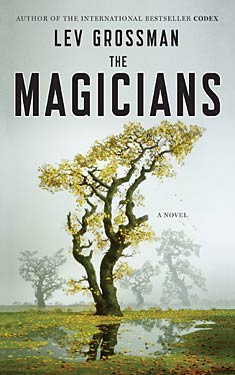
Review: The Magicians by Lev Grossman


This post marks the beginning of my review series focused on newer writers, which I am writing for the WWEnd.com blog.  Worlds Without End has a number of great review series to read, including "Forays Into Fantasy", "SF Manga 101" and the many reviews from the 2013 Women in Genre Fiction Reading Challenge! The first section below is an introduction to the ideas behind my series, and the second is a review of Lev Grossman's The Magicians.  

I’ve been drawn to science fiction and fantasy since I learned to read. As I imagine is the case with most speculative fiction fans, at the core of my continuing fascination is the insatiable desire to read stories that are, in some way, unlike what I have read before. Sometimes I find very familiar stories told in new ways, such as Jo Walton’s Tooth and Claw. Sometimes I find stories that are entirely unfamiliar to me, such as in Catherynne M. Valente’s Deathless. Sometimes I’m amazed by the creative mind of the author, as in MiĆ©ville’s Perdido Street Station, or by the extrapolation of current trends to bizarre future societies, as in Rajaniemi’s The Quantum Thief. Speculative fiction is such a wide field and the stories to be told are limited only by the imagination and skill of their creators.

Of course, the only way to continue to enjoy these new kinds of stories is to constantly stretch one’s horizons as a reader. WWEnd’s convenient awards rankings, theme book lists, and now yearly challengeshave helped me to continue to expand my experience of genre fiction. As a continuation of this, I am going to make a special effort to read and review the debut novels of relatively new authors in the field. The John W. Campbell Award for Best New Writer will guide my selections, but I will necessarily branch out to other new authors that catch my interest. Through this series, I hope to discover many new and upcoming authors, and to possibly bring them to the attention of others.
I’m beginning with Lev Grossman’s The Magicians, for which he won the 2011 John W. Campbell Award for Best New Writer*. I know this book is far from unknown, but I think it is a good place to begin my study of new authors in science fiction and fantasy.

*The 2012 winner was E. Lily Yu, for a short story located here, free of charge. I would feel silly writing a review of it, when anyone could read the actual story just as quickly!

The Magicians
The Magicians by Lev Grossman
Published: Viking UK and William Heinemann (2009)
Series: Fillory: Book 1

I will try to steer clear of most spoilers, but I will describe the plot in general terms. Read at your own risk!

As is common these days, Grossman has a website and blog where one can find information about his publications, authorial activities, and more. In actuality, The Magicians is not Grossman’s first novel, since it is predated by the thriller,Codex (2004),and a novel of aimless post-graduate trekkie life, titled Warp (1997). The Magicians is his debut in the fantasy genre, though I wonder if some parts of the depiction of ‘aimless post-wizard-school life’ are informed by his work writing Warp. In terms of age suitability, The Magicians contains a lot of substance abuse, sexual content, and some violence.

The Magicians has been popularly described as “Harry Potter for adults”, a phrase that I’m afraid will soon become too common to be a useful descriptor. At least in one way, it is literally true here—the novel tells the story of a group of 18-year-olds who are unexpectedly invited to attend a hidden college of magic, called Brakebills. The main character is Quentin Coldwater, a perpetually dissatisfied teenager and academic overachiever who is obsessed with a series of British books about a fantasy world called Fillory. The first part of the story follows his years at Brakebills, where he and the other academically driven students live in an abnormally strict prep-school-style community. Quentin eventually develops a close-knit group of friends who study together, reluctantly play strange competitive magical sports, fall in love and/or lust, and drink lots of wine. After graduation, Quentin and his friends flounder until they find a new purpose—going to Fillory, a world that may be not so fictional after all.

The characters in The Magicians are believable, but a little difficult to like. Quentin and his friends mostly view the world with bored cynicism and contempt, despite the magical wonders around them. Quentin is particularly irritating, with his insistence on being miserable in all situations. He was one of those people who are convinced that ‘real’ happiness occurs only when the universe forces it on you. Therefore, he just wanders through life aimlessly, whining constantly that the world isn’t making him happy. I felt most sympathetic towards Quentin during his time at Brakebills, where he found unexpected joy in the camaraderie of his small group of friends. I could appreciate Quentin’s quiet desperation to preserve that transient sense of belonging.

In the same way, I was most affected by the portrayal of the college and post-graduate lives of Quentin and his friends. Despite the magic, some of the highlights of their college experience are not all that dissimilar (in theme) to real life. I can appreciate the friendships that arise through studying and relaxing together day after day, and the cold dread when you realize that the group will likely disperse after only a few years. Similarly, I recognize the lack of purpose that can descend after spending seventeen years in a highly regulated school environment, only to find that you aren’t sure what to do with all that accumulated knowledge. It can be hard to switch from measuring yourself by academic achievement to setting and achieving your own personal goals. Quentin and his friends don’t deal with any of these situations particularly well, but I suppose that is also quite realistic.

The Magicians
Concerning the more fantastical side of the story, it’s very clear that The Magicians has strong influences from existing works in the genre. Grossman even highlights this fact with explicit references to Harry Potter,Lord of the Rings, Dungeons & Dragons, and probably others that I didn’t catch. The one influence that affects the story most heavily, though, is C.S. Lewis’s Chronicles of Narnia. The Fillory and Further novels, by fictional author Christopher Plover, are clearly modeled after Lewis’s work. Though the connection between the two is obvious, there are differences between Fillory and Narnia—Fillory does not appear to be a Christian allegory, and it plays a different kind of role in Quentin’s story. However, I couldn’t quite figure out if Fillory was intended as a darker, more cynical homage to Narnia or a mockery. Specifically, there were certain personal insults leveled at Plover that did not sit well with me, considering that he is a reference to an actual deceased person. Aside from this, most of the references were fun to pick out, and I liked how it emphasized that the characters of The Magicians were familiar with these enduringly popular classics of fantasy.

While the heavy influence of other fantasy works is undeniable, Grossman puts his own twist on some things. I most enjoyed how magic was treated as a legitimately difficult discipline. As in other disciplines, such as music or physics, one can only become more skilled through constant, intense study. Even after graduation, the magicians can’t just re-order reality on a whim. Some of them are capable of remarkable feats of magic, but only when given time for study and preparation. I really loved seeing the ‘nuts and bolts’ of the practice of magic, as Quentin and his friends studied at Brakebills.

In the end, there were many things that I felt The Magicians did well, though there were some things that bothered me. I enjoyed the portrayal of college and post-graduate haze, though I was less interested in the stories of Fillory. The characters were deeply flawed, possibly to the extent of being unlikeable for some readers. There were plenty of allusions to previous works in fantasy, but the grimly realistic tone and interesting take on the study of magic set this novel apart. The Magicians was an interesting introduction to Grossman’s work, and I will probably try more of his novels in the future.