Friday, March 9, 2012

Review: Mona Lisa Overdrive, by William Gibson


Mona Lisa Overdrive by William Gibson
Published : Gollancz/Bantam Spectra, 1988
Series : Book 3 of the Sprawl Trilogy
Awards Nominated : Hugo, Locus SF, and Nebula Awards

Warning:  This is the third novel of a trilogy, and it may include spoilers for the first two novels (Neuromancer and Count Zero). 

The Book :

“Enter Gibson's unique world--lyric and mechanical, erotic and violent, sobering and exciting--where multinational corporations and high tech outlaws vie for power, traveling into the computer-generated universe known as cyberspace.

Into this world comes Mona, a young girl with a murky past and an uncertain future whose life is on a collision course with internationally famous Sense/Net star Angie Mitchell. Since childhood, Angie has been able to tap into cyberspace without a computer.

Now, from inside cyberspace, a kidnapping plot is masterminded by a phantom entity who has plans for Mona, Angie, and all humanity, plans that cannot be controlled... or even known.

And behind the intrigue lurks the shadowy Yazuka, the powerful Japanese underworld, whose leaders ruthlessly manipulate people and events to suit their own purposes... or so they think.” ~WWend.com

I read Neuromancer many years ago, and read Count Zero for this blog last year.  The first two books have very little connection to one another, and can, I think, be read independently.  Mona Lisa Overdrive, on the other hand, brings back characters from both of the previous two novels.  Enough of the plot of the first two books is rehashed through dialogue that a new reader wouldn’t get too lost, but I think that it would be best to read this one after both Neuromancer and Count Zero.

My Thoughts :

Neuromancer was told from a single point-of-view, and Count Zero featured three main characters with disparate plotlines that converged in the end.  Mona Lisa Overdrive moves further in this direction, with 4 even more disparate plotlines.  I’ve enjoyed Gibson’s well-developed world (and cyber-world), all through the Sprawl Trilogy, and I think his writing style is getting more interesting with each novel I read. I also feel like the main characters in Mona Lisa Overdrive were some of the most complex, interesting characters I’ve yet seen in Gibson’s novels.  However, the plot of Mona Lisa Overdrive seemed a little muddled and over-complicated, and I didn’t really feel as though the four plotlines converged in a satisfactory way by the end.

Each of the plotlines in Mona Lisa Overdrive is connected in some way to events in the previous two books.  One main character, Angie Mitchell, was a major player in Count Zero.   Now, she’s a rich simulation star, and her boyfriend (Bobby, from Count Zero) has vanished.  In addition to coping with the stresses of stardom, she’s still dealing with the implications of her father’s meddling with her brain as a child. Second, there’s the ex-con Slick Henry, who reluctantly takes Bobby’s wired-in body under his protection.  Slick, whose character I believe is loosely based on the artist Mark Pauline, creates art in response to the psychological trauma inflicted by his bizarre prison sentence.

Third, there is Mona, an uneducated prostitute who looks strikingly like Angie.  She finds herself in the care of dangerous men who want to use that resemblance for their own ends.  Lastly, there’s Kumiko, a Yakuza boss’s daughter who has been sent to ‘safety’ in London while her father engages in gang warfare.  Kumiko, who is still trying to come to terms with her mother’s suicide, befriends Molly Millions (of Neuromancer), who is being blackmailed by someone off-screen.

I enjoyed reading about Mona, Slick, Angie, and Kumiko, but their stories didn’t have much momentum.  Mona’s story seemed to have the most tension, as she was stuck in a clearly dangerous situation that she didn’t fully understand.  However, all of the main characters, including Mona, seemed to be in something of a holding pattern.  I think there was just so much information to distribute and so much setting up to do, that it sort of seemed like all the characters were just waiting around for the eventual climax of the novel.   

When the novel’s climax did eventually come, and the four plotlines converged, it was a little bit of a letdown.  The ending was pretty entertaining and action-packed, and it was fun to see the characters from all three novels interact.  However, a lot of characters motivations (particularly the villains) didn’t seem to make a whole lot of sense. Also, the relative time spent developing various characters throughout the story did not seem to accurately reflect their importance to the overall novel. Considering how convoluted the story was, I suppose it is unsurprising that the final knot seemed to have a few loose threads. Even so, Gibson’s interesting world and engaging characters still left me happy to have read Mona Lisa Overdrive.  

My Rating : 3.5/5

Neuromancer starts with four wildly disparate plotlines, and it also includes various characters from the previous two novels.  The four plotlines feature compelling main characters, but their stories never quite seemed to merge successfully.  The plot is interesting, but it is so unnecessarily complicated that everything seems to be bogged down by the weight of exposition. Some major plot points revolved around characters who were only briefly even present in the story, and whose motivations never made an awful lot of sense.  Still, I was glad to see Gibson’s gritty future society again.  It was fun to see characters I knew from previous novels, and the four main characters might be my favorite Gibson characters so far.  In the end, I’d say I liked this novel about as much as Count Zero, but for different reasons.

Monday, March 5, 2012

Review: The Stars, Like Dust by Isaac Asimov


The Stars, Like Dust by Isaac Asimov
Published : Doubleday, 1951
Series : Book 2 of the Galactic Empire
The Book :

“Biron Farrell was young and naïve, but he was growing up fast. A radiation bomb planted in his dorm room changed him from an innocent student at the University of Earth to a marked man, fleeing desperately from an unknown assassin.

He soon discovers that, many light-years away, his father, the highly respected Rancher of Widemos, has been murdered. Stunned, grief-stricken, and outraged, Biron is determined to uncover the reasons behind his father’s death, and becomes entangled in an intricate saga of rebellion, political intrigue, and espionage.

The mystery takes him deep into space where he finds himself in a relentless struggle with the power-mad despots of Tyrann. Now it is not just a case of life or death for Biron, but a question of freedom for the galaxy.” ~barnesandnoble,com

This is my second novel read and reviewed for the Grand Master Reading Challenge over at WWEnd.comI’ve been a big fan of Asimov’s work, ever since I discovered I, Robot as a kid.  I’ve since read the majority of his novels and short stories, but I’d never read any of this particular trilogy (Pebble in the Sky, The Stars, Like Dust, and The Currents of Space).  Thus, when I saw The Stars, Like Dust in a used bookstore, I grabbed it.  If I’d done a little research first, I suppose that I would have discovered Asimov has apparently referred to this one as his “least favorite novel.”  In any case, it’s an interesting look at a lesser, early novel of Asimov’s.  The Stars, Like Dust, contains a standalone story, so I don’t think the novels that comprise this trilogy need to be read in order.

Sadly, there won't be much more Asimov featured on my blog, only because I've pretty much read most of his work, and I don't generally re-read.  If you really want to get into Asimov (and who wouldn't?), his robot short stories are a good place to start.

My Thoughts:

The Stars, Like Dust seems like a pretty typical pulp SF adventure story.  There’s an evil empire (the Tyranni), a plucky young hero with a crew cut and well-trained muscles (Biron), a secret rebellion, a feisty love interest (a pretty girl named Artemisia), and even a helpful old inventor.  Most of the details of the plot, and the various twists, seem pretty clichéd, though I imagine that might not have been the case back when it was published. 

The characters do little to break out of their one dimensionality.  Artemisia has little to do in the story besides fall for the hero; she’s an aristocrat on the run from her arranged marriage with a powerful older man.  Biron is the typical naïve, ignorant young man who ends up being somehow vastly more capable—physically and mentally—than everyone around him. It doesn’t help that the writing itself also seems clunky, and the dialogue doesn’t seem to flow naturally. There is also a rather ridiculous subplot about mysterious ‘important Earth document’, which I have heard was added against Asimov’s will.

If you’re willing to go along with a fair amount of cheesiness, however, the story is pretty fun.  I think that The Stars, Like Dust is clearly one of many similar stories that contributed to the imagining of Star Wars, though this earlier novel misses some of the strengths in plot and character that made Star Wars such a cultural phenomenon.  The Stars, Like Dust, is  a fast read, and I kind of enjoyed reading such an example of campy 50’s Sci-Fi.

My Rating: ~/5

The truth is, I don’t want to rate this novel.  Therefore, I won’t.  I can’t in good conscience say it is a good novel. However, I did enjoy it, at least as a glimpse into Asimov’s earlier, lesser-known work.  This is also, apparently, Asimov’s least favorite novel, so it was interesting to see what he considers the worst of his large and mostly impressive body of work.  I think The Stars, Like Dust is a novel that would mostly appeal to Asimov completionists, though it’s also a fun, short little novel for anyone who wants a dose of good-natured, corny, 50s-style, pulp SF star-spanning adventure. 

Wednesday, February 29, 2012

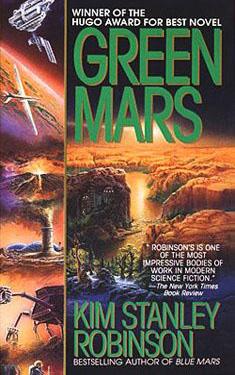
Review: Green Mars by Kim Stanley Robinson


Green Mars by Kim Stanley Robinson
Published : 1993, HarperCollinsUK/Bantam Spectra
Series : Book 2 of the Mars Trilogy
Awards  Won : Hugo Award, Locus Science Fiction Award
Awards Nominated : Nebula and British Science Fiction Association Awards

Spoiler Warning:  This review contains some details of the plot of the first novel of the trilogy, Red Mars

The Book :

“Mars: the Green Planet. Man's dream of a new world is underway but corrupted. Red Mars is gone, ripped apart by the violent and failed revolution of 2061. The First Hundred have scattered or died, and for the moment their dreams with them. The rebels are underground, dreaming of their utopia. The transnational corporations have a dream, too. Mars can be plundered -- for the benefit of a ravaged Earth. It can be terraformed to suit Man's need -- frozen lakes form, lichen grows, the atmosphere slowly becomes breathable.

But most importantly, Mars can be owned. On Earth, countries are bought and sold by the transnationals. Why not Mars too? Man's dream is underway, but so is his greatest test. The survivors of the First Hundred -- Hiroko, Nadia, Maya and Simon among them -- know that technology alone is not enough. Trust and co-operation are need to create a new world -- but these qualities are as thin on the ground as the air they breathe.” ~WWend.com

At long last, I’ve read the second novel of the Mars Trilogy! I’ve always intended to finish KSR’s story of Martian colonization, and I’m looking forward to reading the concluding novel, Blue Mars  (though with my current rate, I’m guessing I will read it in early 2013).

My Thoughts:

Green Mars involves some dramatic events, but it is a very, very slow-paced novel.  It is a continuation of the story that began in Red Mars, so I would definitely recommend reading that novel first.  The First Hundred are still around, thanks to their anti-aging treatment, and they face many of the same problems.  They still need to find a way to establish a non-dependant and non-submissive relationship with the troubled Earth, which is increasingly controlled by powerful corporations.  The debates about terraforming—to what extent and by what means it should be done—still rage.  However, no matter what decisions are made, Mars is slowly and inevitably changing.  The physical environment is being permanently altered, and new generations of Martian-born people are coming of age, people who know Mars as their only home.

Much of Green Mars is dedicated to explorations of the landscape, and to debate about the major political, sociological, economic, and environmental problems that face those who want to form an independent Martian society.  Some very interesting segments featured scientific or political conferences.  I enjoyed how relatively fairly Robsinson portrayed many different points of view.  The issue wasn’t for the ‘right’ people to be triumphant, but for many groups of people with varying cultural backgrounds and beliefs to find a way to work together.  I think the conferences themselves were very realistically portrayed, as was the difficulty in coming to any kind of consensus.

Like Red Mars, Green Mars is separated into long sections, told from the third-person point of view of various characters.  Given the high amount of dry ideological debate and geographical detail in the novel, feeling a connection with the characters was absolutely essential for me to feel engaged by the story.  There were some parts, more notably early in the novel, where the point-of-view was not as strong as I would have liked, leaving me feeling a little detached from events.  As the book progressed, though, I felt more involved, particularly as it built up to the final, breathtaking conclusion.

A few new characters were added to the cast for Green Mars: the young Martian Nirgal, and the Earthman Art Randolph.  I can see how these characters were useful additions as viewpoint characters.  Nirgal provided insight into the state of mind of the new generation of Martians.  I didn’t strongly dislike Nirgal’s personality, but I felt that he was portrayed as a little too perfect and special, especially initially.  He’s wise, charismatic, attractive, and has strange powers of metabolic control.  His metabolic powers are never really explained, and I felt like the novel could really have done without them.  Art Randolph provides an interesting look into the state of the deteriorating Earth, and his sense of wonder for Mars is a pleasant addition.  Overall, I felt that these were valuable viewpoints to add to the story, though Art, in particular, seemed little underutilized.

Of course, many of the characters from Red Mars also made another appearance as viewpoint characters.  The First Hundred, now down to less than half their number, still wielded considerable influence. I really enjoyed Nadia’s segments, but I think that Sax and Maya were the most notably developed throughout the story of Green Mars. Sax, who was mostly a lab worker in Red Mars, began to take a much more active role in the problems that faced Mars.  I was not much of a fan of Maya in Red Mars, but she became much more aware of her own weaknesses and mental issues.  Maya’s sections most clearly showed the psychological toll that the longevity treatment was taking on the First Hundred. Overall, this is a cast of characters that I will gladly follow into Blue Mars. 

My Rating: 4/5

Green Mars is an incredibly dense, thorough, and slow-paced continuation from the Mars colonization story that began in Red Mars.  Green Mars features the development of a Martian ecology and society, and it is filled with many debates between disparate groups about how each of these things should develop.  Many familiar faces show up as viewpoint characters, such as Nadia, Maya, and Sax, as well as a few new characters, such as the Martian Nirgal and the Earthman Art.  For me, the story picked up interest significantly in the second half of the novel, and it came together in the end to a very satisfying conclusion.  I don’t think I enjoyed this quite as much as Red Mars, but I still think it was an impressive work of science fiction.