Showing posts with label Lois McMaster Bujold. Show all posts

Sunday, October 14, 2018

Review: Mirror Dance by Lois McMaster Bujold

Mirror Dance by Lois McMaster Bujold
Published: Baen, 1994
Series: Book 9 of the Vorkosigan Saga (chronologically)
Awards Won: Hugo and Locus SF Awards

The Book:

“Miles met his clone--a young man raised by rebels to murder and replace him--in Brothers in Arms. Miles insisted that the clone was legally his younger brother, and thus entitled to the name ‘Mark Vorkogian’, but the abused and indoctrinated young man ultimately fled him in distrust.

Some time later, Mark is struggling to come to terms with his past in the cloning creches of Jackson’s Whole.  While his upbringing was a nightmare, it was less horrible than the fate that met all of his childhood friends.  They were raised as bodies to grant immortality to the rich, and their brains were simply discarded at maturity. This is still happening, day after day, and it is a horror that no one is taking any action to stop.  

Mark can do nothing alone, but he knows his well-connected “brother” Miles has a mercenary fleet.  He still believes Miles can’t be trusted... but he was raised to impersonate him. Mark may not have Miles’s strategic ability or experience, but he’s determined to succeed or die trying.” ~Allie  

This is the next book I read via audiobook with my husband.  I think it was pretty accessible, even though my husband had not read any of the other books in the series.  I’d recommend reading Brothers in Arms, first, though, so that you would already know Mark the clone and the details of Miles’s own double identity.

My Review: 3/5

I’m glad that this book forced Miles and his company to do something about Jackson’s Whole, because the whole cloning-immortality setup there was awful.  I get that the hero can’t fix everything about the universe, but I could really sympathize with Mark’s desire to try to address at least this one thing. It was also interesting to read a story featuring Mark and Miles as side-by-side protagonists. They both had such unique voices and personalities, despite the similarities they share.  I’m also glad Mark had a chance to develop his own identity, separate from the idea of being a copy of Miles.

My main reservations about recommending this novel are that it has uneven pacing and potentially disturbing content. The story has a slow start, becomes very intense during the rescue operations on Jackson’s Whole, slows down dramatically as the action moves to Barrayar, and then picks up again later.  The segment on Barrayar was nice as an interlude to show continuing readers what all the minor characters have been up to, but it felt unnecessarily long when considering this novel in isolation. The disturbing content includes torture and sexual assault, and portrayals of intersexual characters and overweight characters that may not be as well received now as they probably were back when it was originally published.
Altogether, I am still enjoying reading the continuing adventures of Miles Vorkosigan and, this time, his brother Mark.  At its high points, the story was exciting, nerve-wracking and occasionally pretty funny. At its low points, the story slows down tremendously to reintroduce minor characters from other Vorkosigan novels. This is not my favorite of the series, but I’m still excited to continue reading about Miles’s adventures!

Wednesday, October 11, 2017

Review: Brothers in Arms by Lois McMaster Bujold

Brothers in Arms by Lois McMaster Bujold
Published: 1989, Baen
Series: Book 8 (chronologically) of the Vorkosigan Saga

The Book:

“Miles Vorkosigan lives a double life, splitting his time between being a Barrayaran noble and leading a mercenary army under the alias of ‘Admiral Naismith’.  He’s just finished a dangerous mission with his mercenaries, one which was generously--and secretly--backed by the Barrayaran government.  When he arrives on Earth in order to see to his ships’ repairs, though, the promised money is nowhere to be found.

While their resources dwindle amidst communication delays, Miles ends up assigned with his cousin Ivan in the Barrayaran embassy.  The longer Miles and ‘Admiral Naismith’ are stuck in close proximity, the more likely someone is going to figure out his secret.  Miles comes up with a clever tale to explain the mercenary leader’s resemblance to him, about a foreign power growing a clone in an attempt to supplant him.  When an actual double appears, his story begins to look more true than he ever anticipated!” ~Allie

Surprise, I have not stopped reading the Vorkosigan Saga!  I just had a lot of books on my reading list, and this series dropped off my radar for a while.  I am certainly planning to finish the series at some point (including the latest one, Gentleman Jole and the Red Queen).

My Thoughts:

Like Ethan of Athos, this novel feels like a lighter side story. Brothers in Arms does not cover momentous events for the Barrayaran Empire, but is instead a minor caper Miles falls into after the Borders of Infinity novella. The story stands on its own, but I would strongly recommend reading it once you’re already versed in the characters and setting of the overall saga.  Though the characters here are as vibrant as ever, I think it helped that they were already established in my mind from other novels. Brothers in Arms introduces a few important minor characters, but it doesn't really break any new narrative ground for the series. It's still very entertaining, though, and I enjoyed having such a fun and undemanding book to read in the evening.
The most interesting aspect of the story for me was the introduction of the clone of Miles.  The idea of a double is popular in fiction, and I think that using it as a narrative technique can illustrate interesting aspects of a character’s personality. The way a person and their double react to one another is heavily influenced by how they believe they themselves would behave in the opposing situation. In action-oriented stories, it seems like the two often try to destroy one another, which might speak highly of their self-knowledge but not of their decency.  Miles chooses a more unusual path, and his choices led me to appreciate him even more as a rational and compassionate hero.  I’ll be looking forward to seeing where his life next leads him.  

My Rating: 3.5/5

Brothers in Arms is another lighter entry in the Vorkosigan Saga.  The story is completely stand-alone, but I think it would help to already have an understanding of and attachment to the characters involved.  The story involves a stopover on Earth, where Miles learns that his made-up story about a foreign power growing a clone of him is not as fictional as he might have hoped.  It is both amusing and exciting, with some action-packed conflict and suspenseful moments. As usual for the Vorkosigan saga, this novel was a pleasure to read, and it left me eager to carry on with the rest of the series.

Saturday, September 7, 2013

Review: Captain Vorpatril's Alliance by Lois McMaster Bujold

Captain Vorpatril’s Alliance by Lois McMaster Bujold
Published: Baen, 2012
Series: The Vorkosigan Saga
Awards Nominated: Hugo Award

The Book:
“Ivan Vorpatril has a relatively peaceful job as an assistant to Admiral Desplains.  His personal life, though, becomes much less peaceful when he reluctantly opens the door to his cousin, Byerly Vorrutyer of Imperial Intelligence.  Byerly has the seemingly harmless request that Ivan, ever the ladies’ man, work his charm on a certain lady that may be in danger.

Ivan is not the sort to leave a lady in harm’s way, especially a very attractive lady, but he soon learns that Tej and her blue companion Rish are in much more trouble that he bargained for.  Ivan makes a brilliant and unexpected move to ensure Tej’s safety, but his tactics may leave the two of them stuck together for quite some time…” ~Allie 

This is the 9th book I’ve read of the Vorkosigan Saga, so I am nearly two thirds of the way through reading the entire series!  I’ve been trying to read them in internal chronological order, but I’m also reading the latest ones when they show up in the Hugo nominations. I still recommend Shards of Honor/Barrayar as the best introduction to the saga, but Captain Vorpatril’s Alliance seems designed to also give a kind of crash course intro to the universe.

This is part of a series, so there may be spoilers of the series.  There are a few slight spoilers of this book as well, since I was unable to find a way to discuss it that avoided them entirely.

My Thoughts:

In long-running series of any media format, the growing wealth of information on the universe, characters, and notable events may eventually become a barrier to new fans, or even old fans that haven’t read the books in a while.  This saga ranges over a couple of decades of published novels, so I can see how it might be past that point for some readers.  I feel like this novel fills the role of a recap story, designed to revisit and remember characters and events for old readers, and to introduce them for new readers.  The current-time plot is a mix of a romantic comedy and a heist story, with plenty of humor and fun dialogue.  The story seems a little constrained, though, by the intent to touch on as many topics from previous novels as possible, and this also sometimes made it feel a little crammed with information.

The protagonist this time around is Ivan Vorpatril, who I find hilarious, though he is the sort of person that would annoy me to tears in reality.  He’s basically a friendly, professionally un-ambitious pick-up artist.  He has kind of a laid-back cheerfulness that I’ve always thought plays well against Miles’ energy (though Miles makes only a small appearance in this particular novel). The second viewpoint character is Tej, a new addition to the Vorkosigan Saga.  In a lot of ways, Tej’s story, being taken in by a Vor and having to deal with Barrayaran culture, is very similar to situations from earlier novels in the series.  Tej was nice as a match to Ivan’s personality, but she was not a particularly engaging character for me.  While the story was entertaining, there also seemed to be something missing.  Bujold’s novels usually say something interesting about societal norms or gender, but Ivan and Tej fall pretty well in line with a pretty standard romantic narrative.  It was still fun, but just a bit more lightweight than I expected.

In addition to Tej and Ivan’s romance, the story contains a pretty funny heist subplot, and a lot of meet-and-greeting. The first part of the story, where Ivan and Tej meet, was probably my favorite—it was really funny, but Tej also seemed to be in real danger.  After this section, though, the stakes drop considerably.  Tej and Ivan attend a fairly constant stream of dinner parties, afternoon tea, and other social gatherings, where she is able to meet and react to many of the various characters of the Vorkosigan Saga universe as they explain various bits of personal and political history to her.  The heist subplot kept things interesting, but I would have to say this is the lightest novel I’ve yet read in the series.

My Rating: 3/5

Captain Vorpatril’s Alliance is suitably funny and entertaining, but it’s a bit more fluffy than what I would call the usual Vorkosigan Saga novel.  It’s mostly a romantic comedy featuring Ivan Vorpatril, with a small dash of intrigue thrown in from the side of his romantic lead’s ambitious family.  While I enjoyed the novel, I felt that it lacked Bujold’s usual examination of gender or social norms, switching in traditional ‘guy/girl’ jokes instead.  Tej and Ivan cover of lot of ground in introducing characters and events from the series, which made me feel as though this were intended to be a kind of series recap story.  It’s a fun, lightweight novel, but it’s nowhere near my favorite of the series (which is still Barrayar, so far).

Friday, April 12, 2013

Review: Ethan of Athos by Lois McMaster Bujold


Ethan of Athos by Lois McMaster Bujold
Published: Baen, 1986
Series: Vorkosigan Saga (order is debateable)

The Book:
“Ethan Urquhart is a head reproductive scientist on the planet of Athos, in a colony that was founded on strong religious and ideological principles.  Due to advanced technology, they’ve been able to create an all-male society, and they believe that women are dangerous and demonic. However, when their new batch of ovarian cultures come in completely sabotaged, Ethan is sent on a dangerous journey to Kline Station, to secure his world’s reproductive future. 

Almost as soon as he arrives, Ethan finds himself in deep trouble, for no reason he can fathom!  Apparently, the sabotaged ovarian cultures were just a hint of the deeper game being played.  Ethan soon finds himself in way over his head, with the beautiful female mercenary Elli Quinn (of the Dendarii mercenaries) as his partner in crime.” ~Allie

I’m in the long-running process of reading the Vorkosigan Saga, but this one is a bit of an oddity. It doesn’t feature any of the central cast of the storyline (though Elli Quinn is a minor character), and it appears to be a one-shot story. However, it was short, humorous, and fun, and it was nice to get a story from another area in the Vorkosigan universe. As a note, I still recommend Shards of Honor/Barrayar (also sold together as Cordelia’s Honor) as a good starting point for the series.

The Book:

Ethan of Athos felt mostly like a side story in the Vorkosigan universe, but it was a light, entertaining read.  Miles never made an appearance, but the story was packed with the same kind of humor, adventure, intrigue and likeable characters that I associate with the series.  The story plays into some common tropes, but always seems to either take them a bit tongue-in-cheek or subvert them entirely.  The main plot is basically a spy thriller, with Elli Quinn as the one experienced in espionage and Ethan as the ordinary guy reluctantly dragged into the mess. I don’t think Ethan of Athos is the most memorable or profound installment I’ve read of the series, but I enjoyed taking a bit of time to read a fun and undemanding adventure.

While many of the minor characters were forgettable, Elli and Ethan were very pleasant characters to follow.  Ethan in particular was a very lovable guy—responsible (ordinarily), nurturing, compassionate, and extremely clueless about international plots and espionage.  Elli, on the other hand, was skilled and resourceful, and newly beautiful as a result of some post-injury reconstructive surgery.  It would have been easy for this novel to feature Ethan realizing women were hot and falling for Elli, and I really appreciate that it didn’t.  He did come to realize that women were not the demons he’d been taught, and he and Elli worked really well together as a team.  However, he never stopped loving his home planet of Athos, and his love interests in the story were never women.

As is probably obvious from the description, some topics addressed through the story were perceptions of gender and culturally imposed gender roles.  This is not new to the series, as previous novels have introduced the extremely patriarchal Barrayar, gender relations in the aristocracy of Cetaganda, and the equalitarian Beta Colony.  In this case, the treatment is similarly unsubtle, but manages not to seem too overbearing or preachy. While the set-up appears quite simple, Bujold doesn’t portray any society as wholly good or bad.  Athos has its problems with misogyny and Kline Station has issues with homophobia, but both societies still seem to produce many perfectly decent and some not-so-decent people.  Ethan needs to come to terms with his bizarre view of women, but the outside world also needs to come to terms with the fact that there’s nothing inherently wrong with the all-male structure of Athosian society.  Overall, I really enjoyed seeing the clash of the characters’ different perspectives, as they made their way from one crisis to another.

My Rating: 3.5/5

 Ethan of Athos is a fun side story to the Vorkosigan saga, one which I don’t think needs to be read at any particular point in the series.  While it may not be the most impressive installment in the Vorkosigan saga, it still had plenty of adventure and humor, and a few really likeable characters.  Most of the story followed the unlikely partnership of the mercenary Elli and a reproductive doctor of an all-male society, Ethan, as he tripped into a heap of trouble while trying to secure an ovarian culture delivery.  The interplay between various characters’ views on gender and gender roles added another interesting aspect to the story. Altogether, it was a light, entertaining novel, and reading it was a fun way to pass a few hours. 

Sunday, November 11, 2012

Review: Cetaganda by Lois McMaster Bujold


Cetaganda by Lois McMaster Bujold
Published: Baen, 1996
Series: The Vorkosigan Saga Book 6 (by internal chronology)
Awards Nominated: Locus SF Award

The Book:

“When the Cetagandan Empress dies, Miles Vorkosigan and his cousin Ivan Vorpatril are sent to Cetaganda for her funeral as diplomatic representatives of Barrayar. But when the lifelong attendant of the Empress is found murdered, Miles and Ivan find themselves in the thick of things.

Miles tries to play detective in a strange, complicated, and deceptively alien culture, while lascivious Ivan manages to get himself involved with several noble females at the same time – a diplomatic no-no of the first order. As the plot thickens, it becomes clear that to save the Empire, it's up to Miles to do the job. He doesn't mind exactly, but... an adversary's Empire?” ~WWend.com

Cetaganda marks the 6th book I’ve read in the Vorkosigan Saga!  I think there are still plenty of exciting novels ahead, but I’ve been enjoying the series thus far.  Next up is going to be Ethan of Athos, and then I’ll have to see about buying the next batch (they’re mostly sold in omnibuses these days).

My Thoughts:

Cetaganda was a planet-bound mystery, unlike the military adventures of the last few novels I’ve read in this series. The mystery was heavily involved with Cetagandan class politics, so developing the society and culture of the Cetagandan Empire was a major focus of the novel.  To me, the most interesting aspect of the culture was its approach to genetic engineering, specifically the way they used it to create both art and themselves.  There was also some examination of class and gender politics, and the different kinds of power people yield.  It was fun to learn more about a society that has only been briefly mentioned in earlier novels, and there were some entertaining side characters portraying the experience of various social stations.

Though the Cetagandan Empire is a focus of the novel, the main characters are two Barrayarans, Miles and Ivan.  In this foreign setting, they stumble into an intriguing mystery that leads to a humorous adventure.  The contrast between Ivan and Miles’s very different personalities lead to some of the most amusing scenes of the story.  Ivan Vorpatril just wants to have a good time on his trip, hopefully a time full of wine and the company of beautiful women.  He has little patience for Miles’s apparent mystery-mongering, and is often exasperated by his friend’s apparent inability to just let things go.  Though Miles seems to be a magnet for trouble, playboy Ivan manages to get into plenty all on his own with the local ladies.  

Miles, in his early twenties here, is intelligent but still fairly immature.  He thinks poorly of Ivan’s preoccupation with women, but he himself falls head over heels for a pretty (and completely untouchable) woman.  While Miles and Ivan are very, very different people, it’s clear that they do have a loyal friendship, which might be one reason why their arguing comes across as funny rather than mean-spirited. I hope there’s plenty of Ivan in the novels to come, because I think he and Miles have made for a highly entertaining duo every time they’ve appeared so far in the series.

While Miles and Ivan’s adventure does involve surviving assassination attempts, investigating murders, and so forth, Cetaganda still has a decidedly lighter tone than some of the other Vorkosigan novels I’ve read.  Besides Falling Free, I think it is also the most independent of the chronology of the series.  There aren’t many callbacks to characters or events from previous novels, and I don’t think that there are any major changes in Ivan or Miles’s characterization throughout the story.  It feels like more of a humorous side jaunt than a part of the central series’ storyline.  Overall, it was just a light, fun, mystery, and I thought it was well-paced and entertaining.  I don’t think this one will become my favorite of the series, but I did enjoy the time I spent reading it.

My Rating: 3.5/5

Cetaganda is a planet-bound mystery that introduces the structure of the society of the Cetagandan Empire.  I enjoyed reading about the practical Cetagandan approach to genetic engineering, and how that interfaced with their strictly class-based society. Miles and Ivan work remarkably well as the main characters, and the contrast of their personalities injects a lot of the humor into the story.   There’s relatively little dependence on past characters and events, so Cetaganda felt more like a stand alone novel than most others I’ve read in the series.  Altogether, it felt like a light, humorous side adventure that would not suffer much from being read out of sequence.

Tuesday, October 23, 2012

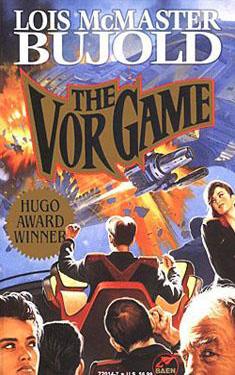
Review: The Vor Game by Lois McMaster Bujold


The Vor Game by Lois McMaster Bujold
Published: Baen, 1990
Series: Book 5 of the Vorkosigan Saga (by internal chronology)
Awards Nominated: Locus SF award
Awards Won: Hugo Award

The Book:

I will avoid plot spoilers as much as possible, but there will be references to Shards of Honor, Barrayar, and The Warrior’s Apprentice.

“Miles Vorkosigan has just graduated from the Barrayaran Military Academy, where he has done well despite physical handicaps and Barrayaran prejudice.  Like most of the other graduates, he has high hopes of being assigned to ship duty.  When his orders arrive, he is shocked and confused to be sent to work as a meteorologist at a remote arctic training camp.

The posting is a test, and Miles wants very much to pass. According to his superiors, he has a tendency towards insubordination, and he needs to prove he has that under control.  As his adventures carry him from the isolated camp back into space and the tricky political and military situation of the Hegen Hub, Miles tries to do what’s in the best interest of Barrayar and its people, regardless of his orders.”  ~Alli

I’m moving right along through the Vorkosigan Saga, and I’ve actually already finished reading Cetaganda (I am way too far ahead in my reading right now).  I don’t think this novel is my favorite of the saga, but it was still entertaining.  Having now read five books in the series, I think I can definitely still say that I prefer reading by internal chronology, and that I think Shards of Honor/Barrayar is the best place for new readers to start.

My Thoughts:

Where The Warrior’s Apprentice concerned Miles’s desperation to prove his worth, The Vor Game seemed to revolve around his difficulty with taking orders.  Miles has the confidence, quick thinking and acting ability to be a skillful strategist, conman, and leader, but he is a truly terrible follower.  I think an army of soldiers like Miles might make a general feel like a cat herder—in some situations, there is such a thing as too much curiosity and initiative.  Due in large part to the prestige of Miles’s family, the government of Barrayar is willing to make an effort to find Miles a role that will allow him to use his strengths to benefit their empire.  I think that this particular kind of conflict is very well-worn ground in military science fiction, since even I’ve seen it play out countless times without actually seeking out military SF.  However, I think that Miles was much more sympathetic than the typical young insubordinate main character, probably because his actions seemed driven by good intentions rather than arrogance.

The novel almost seems to consist of two stories stitched together.  The first half follows Miles attempting to cope with his post to an arctic training camp, and the second half follows him through a complicated political situation in a region of space known as the Hegen Hub.  The difference in tone and pace between these two halves makes me wonder if they were originally planned as separate stories. Personally, I thought that the slower-paced first section was the stronger half, due mostly to the plot’s focus on character motivations. I enjoyed how we got to see the interplay of social class, ableist prejudice, and military rank, as Miles tried to navigate a difficult posting without questioning his superiors or getting killed. I think that I tend to feel more engaged with that kind of small-scale, character-based conflict than the kind involving planetary governments and mercenary fleets.  The second half moved quickly, and was full of the kind of wacky adventures I’m beginning to associate with Miles.  The bad guys were not very nuanced, and Miles successes sometimes seem a little superhuman, but there’s plenty of action and humor to keep the story hopping along nicely.

I’ve touched on this in past Vorkosigan reviews, but I still enjoy Bujold’s approach to writing this series.  Every installment so far has had a plot that works as a standalone novel, but a continuity of character development that rewards those who follow the series.  In this way, it seems every novel will be accessible to new readers, while each installment makes the world and characters feel richer for those who want to read it as a series. For instance, in The Warrior’s Apprentice, Elena had a pretty important character arc based on events from Shards of Honor/Barrayar, and it was nice to see how she was doing in this novel, even though she was not a major character.  In The Vor Game, Miles’s childhood friend Gregor, the Emperor of Barrayar, gets some much needed character development, which is also based on events from previous novels. While enough information is given in The Vor Game for any new readers to know what’s happening, I think many of the character-based plot points are made much more effective by already having experienced the backstory in previous novels.

My Rating: 3.5/5

The Vor Game was an entertaining story that is more rewarding when read after Shards of Honor, Barrayar, and The Warrior’s Apprentice.  The exciting plot of The Vor Game stands alone, but the history of the universe and its characters lends more emotional depth to the story.  The novel seems to be split into two sections, one at a remote arctic training camp and the other following a tricky situation in space at the Hegen Hub. I actually enjoyed the earlier section of the story, featuring Miles and other characters in a relatively closed environment, to the later sections of more star-spanning politics and adventure.  The villains tended to be a bit one dimensional, but I enjoyed hearing about the lives of Ivan and Elena, and seeing Miles and Gregor develop more as characters.  Overall, it was fun, but not a contender for my favorite Vorkosigan novel.

Friday, September 14, 2012

Review: The Warrior's Apprentice by Lois McMaster Bujold


The Warrior’s Apprentice by Lois McMaster Bujold
Published : Baen, 1986
Series : Book 4 of the Vorkosigan Saga (internal chronology)

The Book :

“Between the seemingly impossible tasks of living up to his warrior-father's legend and surmounting his own physical limitations, Miles Vorkosigan faces some truly daunting challenges.

Shortly after his arrival on Beta Colony, Miles unexpectedly finds himself the owner of an obsolete freighter and in more debt than he ever thought possible. Propelled by his manic "forward momentum," the ever-inventive Miles creates a new identity for himself as the commander of his own mercenary fleet to obtain a lucrative cargo; a shipment of weapons destined for a dangerous warzone.” ~goodreads.com

I had a plan to read the entire Vorkosigan Saga, start to finish, months ago.  I read through Falling Free, Shards of Honor, and Barrayar, and enjoyed them.  And then… I think I got distracted?  I kept planning to read the next one, but I never quite got around to it.  At any rate, I do still plan on reading the whole series.  I have the next four books (by internal chronology) lined up and ready to go.  I think I took a break from the series at a good point, at least.  Barrayar ended Cordelia’s adventures, and The Warrior’s Apprentice kicks off Miles’s story.  I still think that Shards of Honor and Barrayar are the best starting place for anyone who wants to get into the series, but keep in mind that I haven’t read them all yet!

I’m reading this series in order of the internal chronology.  Therefore, there will be some spoilers of Shards of Honor and Barrayar in this review.

My Thoughts :

The Warrior’s Apprentice was clearly the start of a new generation of adventures in the Vorkosigan Saga.  All of the babies and toddlers from the time of Barrayar have now become teenagers and young adults.  Of course, there was the irrepressible 17-year-old Miles Vorkosigan, but there was also Miles’s crush, Elena Bothari, his irritating cousin Ivan, and the young Emperor Gregor, who was just coming into his power. Starting with this novel, I began to be impressed by the increasingly complex web of interpersonal relationships that this kind of generational saga can portray. Nothing from the previous novels was forgotten, and the old conflicts, secrets, and vendettas still played a role in the story.  In fact, some of the tensest moments in the story for me involved the younger generation innocently prying into secrets that were better left buried.

It is Bujold’s deft hand at characterization that makes her expanding character base and their web of relationships engaging and easy to follow.  Some of the characters were ones that I was already familiar with from the previous novels, such as Miles’s parents and the troubled Bothari.  Others, such as the group of the ‘Dendarii Mercenaries’ were not really as deeply characterized, but still managed to be easy to tell apart.  Of the Barrayar babies, Miles, Elena, Ivan, and Gregor were memorable from their first impressions alone.  Though Miles and Elena were the most present in the story, I was still left with the impression that Ivan and Gregor would be interesting characters to explore further in the future. Altogether, in terms of establishing relationships and characters, I think this novel was a highly successful introduction to Miles’s life.

Though many of the secondary characters had their own subplot arcs, it was Miles’s coming-of-age issues that formed the backbone of the novel.  While Miles is pretty hyper-capable, I liked how his state of mind was portrayed.  He was an essentially well-meaning young man who had, as a result of the environment of his upbringing, a good amount of unexamined prejudices.  While he is highly skilled at strategy, he also doesn’t always clearly perceive the full consequences of his actions. Basically, a lot of his flaws are a result of his youth and inexperience, and I enjoyed watching him start to overcome them.  The main problems he personally struggles with in this novel are his desperation to prove himself to his parents and his awkwardness in dealing with a crush on his childhood friend Elena.  

Much of his intense desire to prove himself seemed linked to his parent’s attitudes regarding his physical handicap. As we know from previous novels, Miles’s body was harmed before his birth by poison gas associated with an assassination attempt on his father.  His parents felt extremely guilty about the damage their political career inflicted on their son.  The dynamic that played out here was actually very realistic, though the specific situation was, of course, science-fictional.  From the parents’ point of view, his physical disability was evidence of their failure to give him a good start in life.  Their guilt is not because they feel their son is inadequate, but because they gave him a much more difficult life than they intended. From Miles’s point-of-view, things look quite different.  As Miles said, after his father once again apologized for the damage:

 “Apologizing to me again, thought Miles miserably. For me. He keeps telling me I'm all right—and then apologizing. Inconsistent, Father. He shuffled back and forth across the room again, and his pain burst into speech. He flung his words against the deaf door, "I'll make you take back that apology! I am all right, damn it! I'll make you see it. I'll stuff you so full of pride in me there'll be no room left for your precious guilt!" ~The Warrior's Apprentice, Near the Beginning

Miles adventures essentially started with the twin goals of proving himself to his parents and impressing Elena.  His flirting with Elena was almost painful to read, because he was so awkward and inexperienced at courting.  While he didn’t have a consciously sexist attitude, his upbringing on Barrayar inevitably left him with some strangely incongruent ideas about the opposite sex.  His experiences over the course of the novel forced him to examine his own ideas and assumptions more closely, and, I think, to become a better person for it.  

While Bujold’s characters and their development is proving to be the main draw of this series for me, the adventures themselves are also a lot of fun.  I’ve seen mention of Miles and his ‘forward momentum’ several times before, so I’m guessing this is going to be a continuing dynamic.  Miles dives into any interesting situation he finds with both feet, relying on his charisma and his strategic flexibility. This story was a bit lighter and more humorous than Cordelia’s adventures in the previous two volumes, and Miles seemed completely unstoppable.  I commented on Barrayar that Cordelia seemed a little bit too much like an unbeatable action hero, and Miles’s adventures left me with the same feeling.  He’s able to manipulate pretty much everyone around him, and he manages to gain a lot of trust based on some pretty flimsy lies.  All the same, though, Miles is simply a ton of fun to read about.  His story, so far, is consistently both exciting and humorous, with just enough moments of seriousness.  I am looking forward to reading more about Miles’s life!

My Rating : 4/5

The Warrior’s Apprentice is another entertaining installment in the Vorkosigan Saga.  This novel kicks off Miles’s story, as he heads out as an inexperienced 17-year-old in search of adventure.  There’s plenty of adventure to be had, and he soon manipulates his way into someone else’s war by pretending to be the owner of a mercenary fleet.  While Miles’s unstoppable successes were on the edge of credibility, the story was full of fast-paced, often humorous fun.  I enjoyed the adventures, but my favorite part of this novel was the characters.  The Warrior’s Apprentice introduces a new generation of players, including the now-grown babies and toddlers of Barrayar.  Bujold’s characters are as well-drawn as always, and I particularly liked how the addition of the new generation built on the web of relationships and loyalties from the generation before.  I’m actually already near the end of The Vor Game, and I can’t wait to see how Bujold’s saga unfolds!  

PS: Isn't that cover just atrocious? 

Thursday, September 8, 2011

Review: Barrayar by Lois McMaster Bujold


Barrayar by Lois McMaster Bujold
Published: Baen, 1991
Series: Book 3 (by internal chronology) of the Vorkosigan Saga
Awards Won:  Hugo Award, Locus SF Award
Awards Nominated: Nebula Award

The Book:

“Cordelia Naismith left her home in egalitarian, scientifically-advanced Beta Colony to marry the retired military Barrayaran Aral Vorkosigan.  Unfortunately, their peaceful honeymoon period is short-lived. When the dying Emperor appoints Aral as the Imperial Regent over the Child-Emperor Gregor, they are plunged back into the deadly center of Barrayaran politics.

Cordelia, pregnant with their first child, will have to learn to cope with the ‘barbaric’ and complicated high society of Barrayar.  She and Aral must deal with political and physical threats, both from possible foreign opportunists and even more dangerous local enemies, who are not pleased with Aral’s use of his power as Regent.  Aral, Cordelia, and their loyal friends will have their hands full just trying to keep the violent society of Barrayar from eating them all alive.” ~Allie

This is my 4th Vorkosigan novel, 3rd in the internal chronology.  Barrayar follows right after the events of Shards of Honor, so I would recommend reading Shards of Honor first.  I still think Cordelia’s story (Shards of Honor and Barrayar, now also published as an omnibus called Cordelia’s Honor) is a good place to start reading the saga.  I’m looking forward to reading the first novel to feature the famous Miles Vorkosigan, The Warrior’s Apprentice.  

This is also the second half of the July selection for the Women of Science Fiction Book Club (now hosted by Calico Reaction).  I’m a little ridiculously behind on that, but I’m planning to catch up with the August and September books this month.

My Thoughts:

Barrayar is a very different kind of story than Shards of Honor.  Instead of space battles, the focus is on Cordelia’s culture shock, various personal relationships, and Barrayaran politics.  It starts out a little slow, dealing mostly with Cordelia’s interactions with the lords and ladies of Barrayar, Aral’s struggle to be a good Regent, and the personal and social issues of minor characters.  In this daily-life section of the book, I enjoyed learning more about Barrayaran society and the many minor characters, some of who were also present in Shards of Honor.  

Though the story may drag a little bit in the beginning, it definitely picks up a lot of speed by the end.  Barrayaran politics are volatile and violent and they cause plenty of action and excitement in the latter part of the book. Even with this slowly building pace, the story in Barrayar seemed much more focused than Shards of Honor.  Rather than skipping from one situation to another, everything that happens in Barrayar ties in to the overarching plot of the novel.  While it seemed a little meandering in the beginning, everything really came together for a breathtaking finale.

There were a couple of specific things in Barrayar that bothered me a little.  The novel opens with Cordelia staring into a mirror and describing herself.  She then proceeds to physically describe the other major characters in relation to herself.  I don’t think there’s anything inherently wrong with including physical descriptions in a novel, but I feel like the mirror trick is typically associated with inexperienced authors.  It started the novel on a contrived note, but Bujold’s writing definitely rises far above that point. 

The other main problem I had, which I touched very briefly on in the review for Shards of Honor, is Cordelia’s infallibility.  It sometimes seemed like the universe would bend over backward to make her every decision become the correct one.  Also, no matter how much trauma she went through, I don’t think she’d ever reach a point where she lost her ability to handle the situation.  I’m not saying she’s an annoyingly perfect character, as she does have a fairly well-rounded personality.  I think it’s just because she’s an action hero(ine), and those types of characters have a tendency to succeed no matter the odds and endure through any hardship.  It definitely makes for a fun adventure, but it causes the resolution of some situations to feel pretty unrealistic.  

One of my favorite parts of the novel was the focus on the development of minor characters.  There’s a subplot involving female bodyguard Droushnakovi and the male secretary Koudelka, crippled in Shards of Honor.  I enjoyed learning more about Sergeant Bothari, a conflicted character also featured in the previous book.  We also meet a large cast of powerful Barrayarans, who will probably be important characters in the books to come.  I thought it was a little odd, however, that there seemed to be very little focus on the relationship between Cordelia and Aral.  Concerning the speed with which they rushed to marriage in the previous novel, I expected to see them coming out of the ‘honeymoon phase’ in Barrayar.  However, their relationship seems to be taken as given, and they spend a large part of the novel apart.  Altogether, though, the cast of characters is shaping up to be one whose adventures I will happily follow through the rest of the series!

My Rating: 4/5

Barrayar is my favorite Vorkosigan novel to date, though I would recommend reading Shards of Honor first.  Barrayar is a planet-bound story, instead of a space-faring one, and the early focus is on politics, culture shock, and personal troubles instead of galactic war.  While it starts out with a seemingly aimless, everyday life quality, it builds to a very fast-paced, action-packed finish. I enjoyed the amount of character building packed in this novel, particularly for the many minor characters.  My main complaints have to do with the characters of Aral and Cordelia.  I was surprised at the lack of any conflict within their relationship, and I was a little irritated by the unstoppable action hero aspect of Cordelia’s character. Overall, I feel like the cast of the Vorkosigan Saga is starting to really come together, and I’m looking forward to reading The Warrior’s Apprentice, the first novel (by internal chronology) to feature Miles!    

Wednesday, July 13, 2011

Review: Shards of Honor by Lois McMaster Bujold


Shards of Honor by Lois McMaster Bujold
Published: Baen, 1986
Series: Book 2 of the Vorkosigan Saga
The Book:
“Cordelia Naismith, of the democratic, scientifically-oriented Beta Colony, was heading an expedition to an uninhabited planet when disaster struck.  Instead of dealing with dangerous flora or fauna, the surveyors found themselves facing soldiers from the 'barbaric', militaristic society of Barrayar!  After what was meant to be a routine arrest turned deadly, Cordelia was stranded with a gravely injured colleague and the former Barrayaran leader, the infamous “Butcher of Komarr”, Aral Vorkosigan.
As they both learn to see past reputations and stereotypes, both Cordelia and Aral grow to respect, trust, and possibly even love each other.  But as Barrayar is poised to go to war with an ally of Beta Colony, what kind of relationship could the two of them possibly have together?” ~Allie
This is the 2nd book of the Vorkosigan Saga by internal chronology, and the 3rd that I’ve read (after Cryoburn and Falling Free).  In addition to my plan of reading the Vorkosigan Saga in order, Shards of Honor is also part of this month’s pick for the 2011 Women in Science Fiction Book Club, formerly hosted by the now-inactive Dreams & Speculations blog, and picked up by Calico Reaction.  The actual challenge is the omnibus Cordelia’s Honor which contains both Shards of Honor and the next book in my Vorkosigan Saga reading, Barrayar.
My Thoughts:
Shards of Honor is the story of a romantic relationship, but the story is not what I would consider a conventional romance novel.  The principal leads, Cordelia Naismith and Aral Vorkosigan, are not blinded by passion and they don’t really fall into each other’s arms.  Aral and Cordelia are both near middle-age, have established careers, and are aware of the unfortunate incompatibility of their two lives. They deal with their slowly growing relationship with practicality and responsibility.  Cordelia is not about to drop everything to go running after Aral, and Aral, with his horrific reputation, is realistic enough to know he would not be accepted in Cordelia’s world.  Their subdued romance is the thread that winds through all of the other events of the story. I enjoyed watching the circuitous path their lives took towards each other.
 While I did enjoy the plot, there were a few elements that seemed a little contrived.  First of all, there is the initial segment of the book, where Cordelia and Aral end up stranded together on an uninhabited planet. To put it into generic terms, two very different people are stranded in a hostile, isolated environment, where they eventually overcome learned prejudices and become friends/lovers. I feel like I’ve seen this plot device fairly often.  Off the top of my head, I can think of a couple of episodes of Star Trek and at least 2 separate Gundam series that featured it. Admittedly, Bujold doesn’t follow the formula exactly.  A severely brain-damaged man accompanies Cordelia and Aral, and the two of them don’t exactly have the health, time, or energy for a whirlwind romance.   All the same, I thought that the plot choice did make their initial meeting and acquaintance feel a little forced.
The other major situation that left me rolling my eyes (good-naturedly) was Cordelia’s battle against therapists.  At that point in the story, she had been through some truly traumatic experiences, and she had acquired some gut-wrenchingly awful top-secret information.  Even so, her general attitude was, “Therapy is great for other people, but I’m fine!”  I think it would have made sense for Cordelia to genuinely be in need of therapy, but to hold back out of fear of revealing dangerous secrets.  Instead, the situation seemed to be framed as a completely un-traumatized Cordelia being driven to distraction by a handful of well-meaning but destructively overzealous therapists.  While it was mostly played for humor, I would have liked to see a more realistic conflict play the role that this situation ended up serving in the overall story.
While Aral and Cordelia’s relationship tied the book together, there’s a lot more to Shards of Honor than romance and therapists.  It ‘s a space opera, with all the politics, intrigue, and space battles that typically entails.  The pace is very rapid, there’s tons of action, and there’s plenty for both Aral and Cordelia to do.  They’re both very resilient, intelligent, and active characters, and they’re both constantly solving one crisis after another.  It seemed like a very tightly planned book—there was never a point where I felt the story dragged.  The characters weren’t incredibly complex, but they were strong enough to shine through all the battles and political maneuvering.  
My last impression of Shards of Honor is that it feels essentially like a set-up book for adventures to come.  Arguably, I feel this way because I know that this actually is the first book that sets up the universe where the famous Miles Vorkosigan will eventually have his adventures.  So far, I think this is the best place to start the series.  It introduces the reader to the cultures of Barrayar and Beta Colony, with some discussion of Komarr.  It also introduces Aral Vorkosigan and Cordelia Naismith, who will be Miles’s parents, in addition to other characters that I hope to see again.  I feel like the stage is set, many of the main players are introduced, and I am ready to dive into the rest of the saga!        
My Rating: 3.5/5
I think Shards of Honor is a great place to start the Vorkosigan Saga, but I might change my mind after I read the rest!  It introduces two major characters, the Barrayaran Aral Vorkosigan and Cordelia Naismith from Beta Colony, and seems to give a good introduction to the universe they inhabit.  Aral and Cordelia’s relationship could be considered the main story of the book, but their romance is wound through an interesting tangle of military and political manipulations, space battles, and alien planets.  While a few parts of the plot seem a little contrived and most of the characters aren’t particularly complicated, the fast pace keeps up the tension and excitement throughout.  Shards of Honor was a very entertaining novel, and I’m looking forward to seeing what Barrayar has in store!

Friday, June 10, 2011

Review: Falling Free by Lois McMaster Bujold


Falling Free by Lois McMaster Bujold
Published: Baen, 1988
Series: Vorkosigan Saga, Book 1
Awards: Nebula
Nominated: Hugo

The Book:

“Leo Graf was an effective engineer...Safety Regs weren't just the rule book he swore by; he'd helped write them. All that changed on his assignment to the Cay Habitat. Leo was profoundly uneasy with the corporate exploitation of his bright new students—till that exploitation turned to something much worse. He hadn't anticipated a situation where the right thing to do was neither safe, nor in the rules...

Leo Graf adopted 1000 quaddies—now all he had to do was teach them to be free. “  ~barnesandnoble.com

I’m finally starting Bujold’s “Vorkosigan Saga” from the very beginning!  Falling Free occurs first in the internal chronology of the series, but it doesn’t feature any of the Vorkosigan family.  Instead this is the origin story of “quaddies”, genetically engineered beings that have two extra arms instead of legs, and are designed to live and work in zero-g.  This seems to be a much better starting place for the series than Cryoburn, if only because it does not assume that the reader is familiar with any people or locations. 

My Thoughts:

Falling Free is a rather simple, straightforward space adventure.  In terms of plot, characterization, and morality, it is much more blunt than I am used to reading from Bujold.  This is not necessarily much of a problem, since I think that it was intended to be a fast, pleasant story about good triumphing over evil.  The blatant moral message is that enslaving people is wrong.  I highly doubt anyone with a shred of decency would disagree.  However, the issue is slightly complicated by the consideration of what constitutes personhood.  The question of what defines a non-human (quaddies are classified as a non-human species) as a person is only addressed lightly in the story, but I think that it a topic worthy of discussion.

The quaddies are designed by a corporation that sees them as very expensive ‘experimental tissue’ instead of people.  Therefore, the company retains rights over their environment, reproduction, and even their lives. The question of their personhood is simplified greatly by the fact that they think and behave exactly like human beings.  Given this, I thought the human staff’s casual acceptance of the quaddies’ predicament was a little hard to swallow. I found myself wondering how the story would have played out if the situation were less clear-cut.  If the quaddies were designed to have the cognitive abilities of an animal, would anyone care about their enslavement?  What if they were given a slightly sub-human level of intelligence?  If either of those situations had been the case, then the untroubled attitudes of most of the human staff would have seemed a little more believable.

Most of the characters are fairly simple, and they fall into easily recognizable roles.  Leo Graf is the reluctant hero.  Even though he risks losing everything he’s ever worked for, he finds himself unable to leave the quaddies to exploitation and possible death.  The villainous Bruce Van Atta and the GalacTech Corporation are unrelentingly evil.  Their abuse of their power over their charges makes the eventual rebellion both necessary and inevitable.  The quaddies themselves are mostly docile and friendly by design, and they are raised in the completely controlled environment of an orbital habitat.  There is a pair of quaddie lovers, Tony and Claire, who found that the corporation didn’t really respect their ideas of love and sexual loyalty.  The most interesting quaddie was Silver, a naïve woman who had been drawn into prostituting herself for information and entertainment from the outer world.  While none of the characters were particularly complex, they fit the tone of the story well.

The story mostly concerned itself with the quaddies realizing their desire for freedom and trying to find a way, with Leo Graf’s help, to acquire it.  It seemed that any time there was a hint of ambiguity about which path was right, the villains (Van Atta and GalacTech) would do something even more horrible, forcing the heroes hands.   I found that a little disappointing, because it seemed to remove the necessity for the heroes to make any truly difficult decisions.  However, there were still enough interesting challenges in the heroes’ way to keep the story exciting.  It was a fun, easy story to read, and I was definitely cheering for Leo Graf and his 1,000 ‘adopted’ quaddies!

My Rating: 3.5/5

Falling Free is was a quick, light, sci-fi adventure novel.  While the premise and the characters are relatively simple, it’s still an exciting story with heroes that are easy to like and villains that are easy to hate. It would have been interesting to have a little more exploration of what constitutes personhood in a non-human species, but that absence didn’t really damage my enjoyment of the story.  I’m guessing the quaddies will show up later in the “Vorkosigan Saga”, and I’m looking forward to possibly seeing how their space-based culture will develop!