Showing posts with label Patricia A. McKillip. Show all posts

Sunday, June 12, 2016

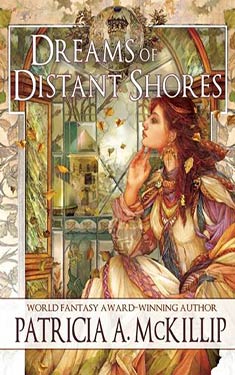
Review: Dreams of Distant Shores by Patricia A. McKillip

This review also appears on the Worlds Without End blog, which can be found here.

-------------------------------------------------------------
Every time I have read one of Patricia A. McKillip's novels, I have been struck by her poetic language and the vibrancy of her fantastical worlds. Therefore, I was delighted to have a chance to read and review an advance review copy of her latest collection of short fiction, Dreams of Distant Shores (to be published June 14, 2016). The book collects seven works of short fiction, one essay by McKillip, and a warm and insightful afterword by Peter S. Beagle.  McKillip's essay is about her style of writing high fantasy, which involves simultaneously following and breaking the rules of the genre.  I enjoyed the glimpse into her writing process, and I think the balance between tradition and originality that she describes is one of the things that has kept drawing me back to her fiction.

The short fiction in Dreams of Distant Shores, though, is far from traditional high fantasy. There are no queens, courts and heroes, and the stories take place in worlds not unlike our own.  I thought the title itself was a remarkably accurate description of the contents within, since each tale felt like a dream permeated by a different style of magic.  The vein of strangeness that runs through every work ties the collection of stories together.

The book opens with the confusing and surreal "Weird".  A man and a woman are locked in a bathroom with a gourmet food basket, while someone or something attempts to break in.  The two of them seem oddly calm, and the woman recounts the weirdest things that have happened in her life.  It's a strange slice of a story, and reading it feels like falling into a fragment of someone else's nightmare.  The story "Edith and Henry Go Motoring" (original to the collection) also feels like a peek into someone else's dream, though a more peaceful one.  Edith and Henry go on an aimless journey in the English countryside, crossing a bridge with an unusual toll to an unexpected destination. I felt that these two stories were the most subtle and elusive of the collection, and I ended up reading them multiple times to try to gain a better understanding.

"Alien" (original to this collection) is another calm tale, and one that feels more grounded in a mundane reality. It features an elderly woman who claims to be visited by aliens, though her family fears she's losing her mind.  It's a lovely and quiet story about growing old, familial relationships, loneliness, and wonder.  Also, I think it must be the most positive alien abduction experience I have ever read.

Moving to the lighter side of the collection, "Mer" (original to the collection) and "Which Witch" are humorous stories with very different takes on the subject of witchcraft. "Mer" follows an immortal, form-changing witch who just wants to settle down into something comfortable and rest.  In the process, she spends some time as a goddess and a wooden mermaid, and gets involved in an unusual local religion.  The story is much less about the witch herself, who just wants a long nap, than it is about the ordinary people with whom she winds up getting entangled.  The vagueness of the magic system works well within the story, since a lot of the humor comes from the characters' exasperation with the confusing events happening around them.
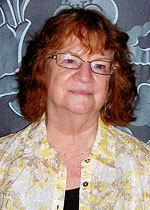
Patricia A. McKillip
Rather than the ancient, formless, sleepy witch in "Mer", "Which Witch" follows a fashionable young woman in a witchy rock band. She's proud to have recently acquired a crow familiar, but the two of them are having issues with communication.  Unfortunately, what the crow is failing to communicate at the beginning of the story is, "You are in terrible danger!" The magic in this story is tied up in music, something that I think is pretty hard to pull off in a written story.  I thought the music as magic sections were pretty fun in this case, though I'm not convinced the musicians would have put on a decent performance!

Moving into the longer fiction, "Gorgon in the Cupboard" was my favorite of the collection. The story involves a community of Victorian painters and models, and the kinds of relationships that exist between them. A middling painter searching for inspiration finds his muse in Medusa, whose spirit manifests in his unfinished painting of Persephone.  Medusa directs him to search for a model, and he looks for someone who will stop him in his tracks and elevate his work.  However, that model is more than a symbol or a mythological figure, but a human woman with her own griefs, thoughts, and dreams.  What follows is an emotional story about how people are shaped by their experiences, and the value of seeing others as they truly are.

The final novella in the collection, "Something Rich and Strange" is a lyrical and imaginative story that carries an overt environmental message. A couple that lives by the coast have a stable life together, until supernatural forces slowly begin to tear it apart.  The man is drawn inexorably to the water by a siren's call, while the woman begins to see strange things in the familiar coastline. It is not long before the situation begins to get really out of hand. The story is beautifully written, and it had some pretty funny moments without losing its fundamental sincerity and gravity.  I'm usually not a fan of including blatant messages in fiction, but the ocean really is in a sad state (though there are some signs of hope).  Altogether, it is a haunting story of a relationship stretched to the breaking point, as well as a call to take responsibility for environmental damage.

In closing, this was an excellent collection of short fiction by Patricia A. McKillip.  Each of the stories takes place in a different world, with a different tone and approach to the supernatural.  With such a range, from the surreality of "Weird" to the Victorian painters of "Gorgon in the Cupboard", I expect it will please fantasy fans with a variety of tastes.  As for me, I have enjoyed visiting each of McKillip's Dreams of Distant Shores.

Saturday, November 14, 2015

Review: The Forgotten Beasts of Eld by Patricia A. McKillip

The Forgotten Beasts of Eld by Patricia A. McKillip
Published: Atheneum, 1974
Awards Nominated: Mythopoeic Award
Awards Won: World Fantasy Award


The Book:


“The powerful, isolated young sorceress Sybel lives alone on a mountain with her animals, wondrous mythical creatures originally summoned over the years by her forefathers.  She is content to spend her life caring for these creatures and trying to summon more, until the day that a man named Coren brings an infant to her door--an infant that is her nephew and also the son of a king. Sybel agrees to care for the child and give it what it needs, which is most of all to be loved.


Through the growing child, Tamlorn, Sybel is once again connected to the world and its troubles.  Tamlorn is eager to know his father, King Drede, but Coren and his family oppose Drede for killing their brother, the late queen’s lover.  Sybel considers herself above all this squabbling, but it is difficult to escape the ties formed from love, fear, and hatred.” ~Allie


This is yet another audio commute book!  I thought this one worked very well as an audiobook, and I really liked the narrator, Dina Pearlman.  This is the second novel I’ve read by McKillip, and I have been enjoying how different her style is from the books I usually choose.


My Thoughts:


This was a fairly small story, focusing primarily on Tamlorn, Sybel, Coren and Drede. There were a variety of minor characters, including the mythical creatures, but it always seemed clear that the four main characters were the axes around which the story turned. This tight focus on a small set of characters, as well as the world of wizards, magical creatures, kings and hidden princes, made the story feel like a fairy tale. This atmosphere was enhanced by the simplicity of the language and dialogue, especially apparent in audio.  I found it completely charming, and often pretty funny.  Especially since I had just finished listening to the end of Gene Wolfe’s Book of the New Sun, it was refreshing to listen to such a relatively light-toned and straightforward story, where most of the characters are trying to be good to one another.


Sybel herself was another reason I was so quickly drawn into the story, as I absolutely loved her personality.  She’s very powerful, intelligent, independent, isolated, and uninterested in politics, and she finds fulfillment in her animals and her magical studies.  I think she completely won me over when Coren brought her the infant, only to almost balk at giving it to her when it became hilariously clear she had no instinctive maternal feelings for the child.  Not that she was averse to acquiring a baby, she just didn’t see why raising it would be any different from caring for her other animals.  Sybel grows and changes through the story, as her love for Tam, among other things, draws her into the politics of the kingdom and into forming personal connections with other human beings.


Sybel’s growth explores various ideas, such as the relationship between love and control, the cost of revenge, and the value of connections with others. Sybel, like her forefathers before her, has the ability to summon humans and other creatures to her, whether they will it or not.  While she loves her animals, they are bound and controlled by her will.  At the beginning, Tam is an exception to this, as she loves him but never attempts to control the path of his life.  As Sybel is drawn into the more complex situation outside her home, she faces much more difficult interpersonal issues, such as the challenges of trust and the danger of a rage that can consume much more than its intended target. I loved seeing how Sybel coped and how her new experiences changed her.  I also enjoyed how everything ended up, and I’m very glad I chose to listen to The Forgotten Beasts of Eld.


My Rating: 4 / 5

The Forgotten Beasts of Eld came up at the perfect time on my reading list, when its simple fairy-tale atmosphere was exactly what I wanted.  The story involves a hidden baby prince, of a king whose marriage was broken by infidelity.  Instead of focusing on the prince, though, it centers around his aunt--a powerful, isolated sorceress named Sybel--who takes him in and raises him.  I thought Sybel was fantastics, and I was delighted to follow her as she became unwillingly embroiled in the politics of the land.  The story involves the importance of interpersonal relationships, and the circumstances that lead people to attempt to control others.  The Forgotten Beasts of Eld was a short, delightful novel that I am glad I have finally read!  

Saturday, November 30, 2013

Review: Ombria in Shadow by Patricia A. McKillip

Ombria in Shadow by Patricia A. McKillip
Published: Ace Books, 2002
Awards Won: World Fantasy Award, Mythopoeic Award

The Book:

“Ombria is a place of both shadows and light, life and death, past and present.  Some doorways may lead you to a familiar tavern, while others may leave you among ghosts or taking tea with a dangerous sorceress.

When the Prince of Ombria dies, the small world of his court becomes a very dangerous place.  His cruel great-aunt Domina Pearl quickly moves to control the heir, an innocent little boy named Kyel.  She also throws the late Prince’s mistress, naïve Lydea, out into the streets to die. 

However, not everything is under Domina Pearl’s control.  Lydea survives the night, and remains determined to help the little boy who has become the new Prince.  The royal bastard Ducon, usually lost in his drawings, must now find a way to preserve Kyel’s life as well as his own. Also, treading fearlessly through their danger is Mag, a ‘waxling’ servant of the powerful sorceress who lives underground. If Kyel—and Ombria—have any hope, it is in their hands.”  ~Allie  

 This is my 11th novel for WWEnd’s Women of Genre Fiction Reading Challenge.  Patricia A. McKillip is a name I’ve heard often, but somehow never got around to reading. This was a pretty short novel, and I finished reading this it in two days, while on a train.

My Thoughts:

The world of Ombria in Shadow is rather dreamlike.  Many small details of the world were described beautifully, while larger concerns were often left quite vague.  There is magic in this world, but its powers and limits are generally not clearly defined. The transitional places in Ombria—doors, for example—don’t always lead into the places you would expect.  People might go through an old door and find themselves in Ombria’s history, surrounded by ghosts.  They might run into the Faey, a face-changing sorceress who sells magic.  Children’s stories also tell of a shadow city, which is somehow both connected to and separate from the Ombria in which the story is set.  All of this was sometimes a bit confusing, but it was easy to just relax and accept each new quirk of the world as it was presented.

I thought it was interesting that while the story was basically political, the main characters were not especially politically motivated.  Lydea, the discarded mistress, was kind of a mix of big sister and mother to the little heir, Kyel.  More than anything, she was distraught to think of what Domina Pearl might do to keep the child (and the kingdom, by extension) under her thumb.  Ducon also seemed more concerned about the welfare of his little cousin Kyel than he was about the state of Ombria.  His main passion, though, was drawing bits and pieces of Ombria with charcoal, and he was only pulled out of that and into the political scene by necessity.  

Mag was possibly the most interesting of the three main characters, as she was raised to believe herself to be the wax construct of a sorceress.  Her upbringing gave her a sense of detachment from the world, and I think her youth and inexperience gave her the fearlessness of someone who doesn’t really understand personal consequences.  As a result, she meddled in dangerous affairs on a whim, seemingly just to help make sure that the ‘winners’ were the people she liked.  These three characters were one of the strengths of the novel, for me, and I really enjoyed the different perspective they showed on a generally familiar kind of story.

In terms of the plot, the novel seemed to be both convoluted in its details and simple in the central story.  The main focus would have to be considered the struggle against the evil Domina Pearl, to stop her from destroying both Kyel and Ombria.  Domina Pearl is not an especially nuanced villain. In fact, I kept thinking of her as a more evil version of Yzma from Emperor’s New Groove.  However, there’s a lot of personal growth for the main characters—for Lydea, as she learns to define herself in her post-mistress life, for Mag, as she comes to understand who and what she is, and for Ducon, who longs to know the identity of his father.  A lot of questions remain unanswered in this short novel, while other parts of the story are wrapped up almost too neatly.  In the end, though, it was a very pleasant two days that I spent immersing myself in the world of Ombria.

My Rating: 4/5
Ombria in Shadow was a short, entertaining novel set in the confusingly magical place of Ombria.  The main plot seemed fairly standard, featuring a succession struggle centering around the evil, ancient Domina Pearl, after the death of the Prince.  I enjoyed that the three main characters—the late Prince’s mistress Lydea, the illegimate royal Ducon, and the ‘waxling’ Mag—were surprisingly un-invested in the political struggle, and cared more for the welfare of specific individuals.  The setting was magical and dreamlike, though many details about the world are left to the imagination.  Overall, it was a very pleasant novel, and I think I will definitely check out more of McKillip’s work in the future.